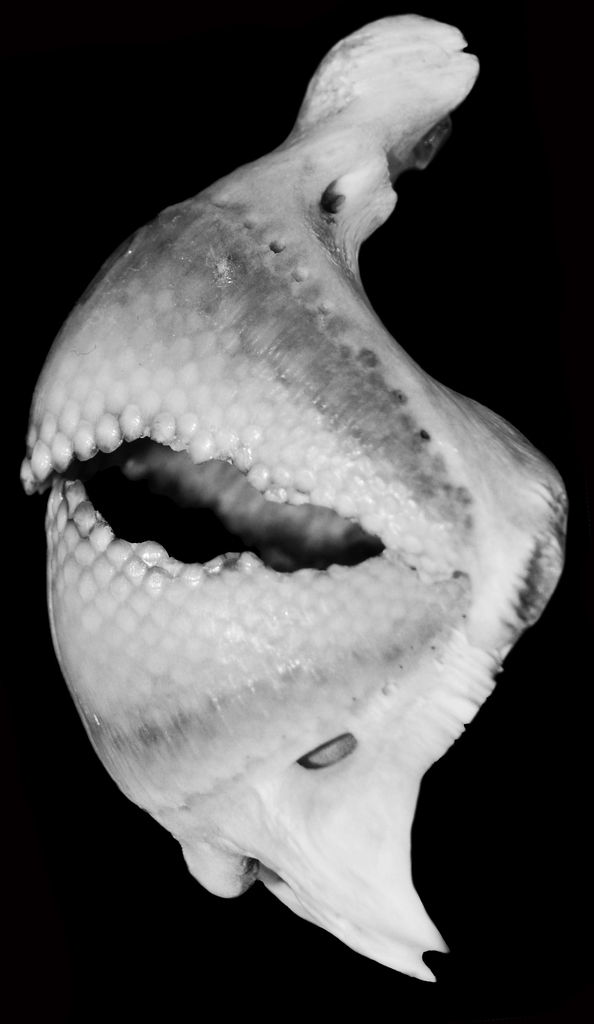
The Conway (Oplegnathus woodwardi) is a saltwater fish of the family Oplegnathidae that grows up to 45 cm.
Description
The knifejaw is a perch-like fish of the knifejaw family (Oplegnathidae) from the temperate waters around southern Australia. The species grows to about 45 cm and has a deep, silvery-grey body; juveniles often bear dark bars that fade in adults. Characteristic is the mouth, in which the teeth are fused into a strong, parrot-like beak with which the fish breaks open hard prey. It lives on the continental shelf and upper slope and feeds on crustaceans, molluscs and sea urchins. Owing to limited data the species is assessed as Data Deficient (DD). It is harmless to humans.
Frequently asked questions
How do you recognise the Conway?
The Conway has a flattened, disc-shaped body, is mainly silver-grey and shows a plain pattern.
Where does the Conway live?
The Conway lives in the sea (marine waters) and is mostly found around sand or mud bottom.
How big does the Conway get?
The Conway grows to a maximum of about 45 cm.
Is the Conway dangerous to humans?
No, the Conway is harmless to humans.
Download Fin's Fish Guide
Identify fish in seconds, log your catches and dives. Join the TestFlight beta.
All data
Identification
Appearance
Habitat & distribution
Behaviour & biology
For anglers
Safety
Status & sources
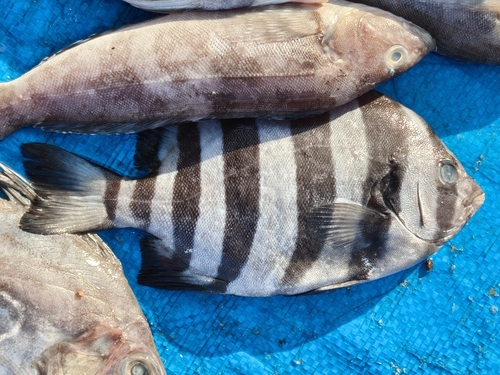
Same genus Oplegnathus
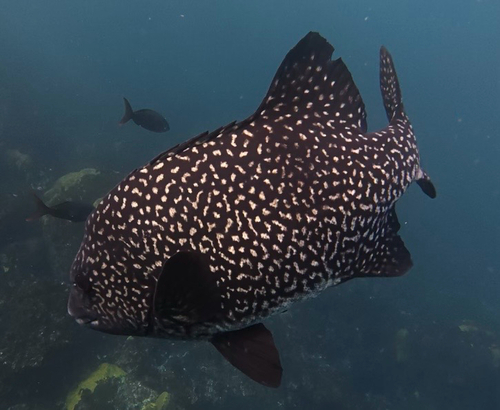
More from the family Oplegnathidae
Download Fin's Fish Guide
Identify fish in seconds, log your catches and dives. Join the TestFlight beta.