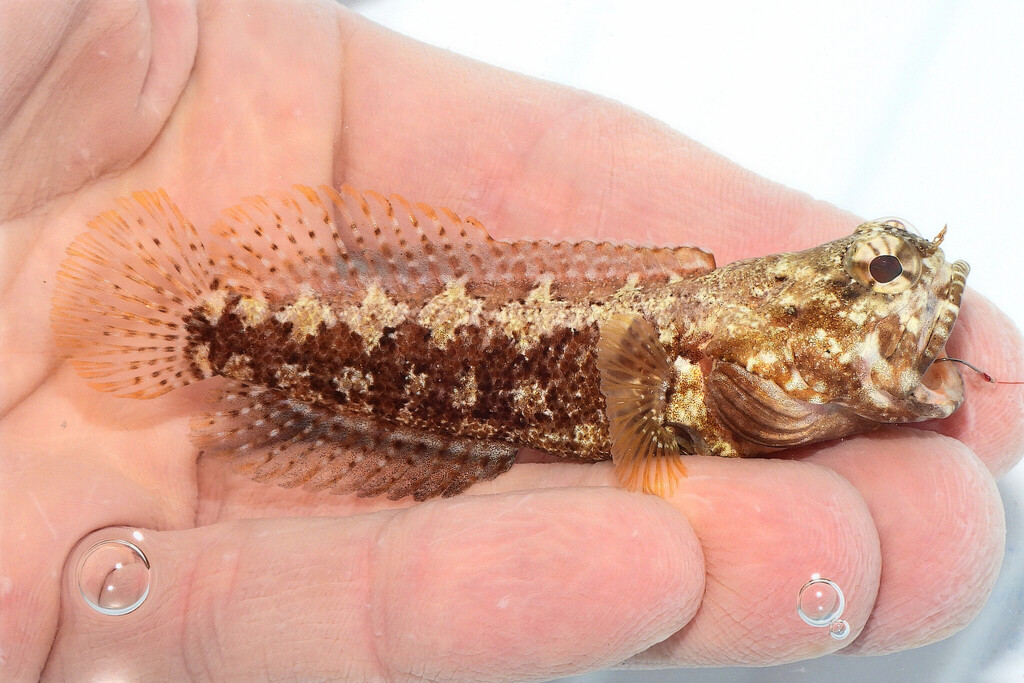
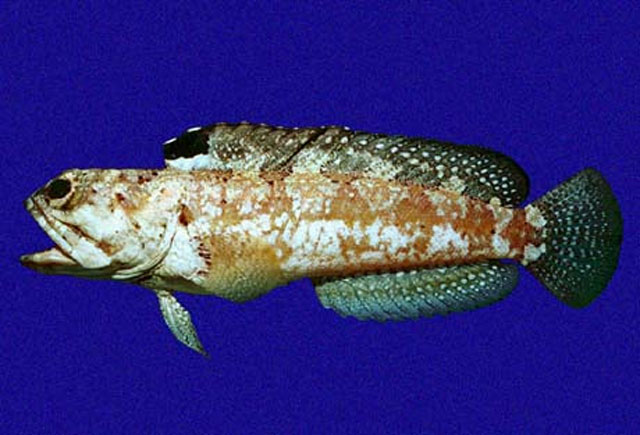
The Dusky jawfish (Opistognathus whitehursti) is a saltwater fish of the family Opistognathidae that grows up to 14 cm.
Description
The dusky jawfish is a small jawfish (Opistognathidae) from the western Atlantic. The species reaches about 14 cm, has an elongate, dark mottled body and a proportionally large head with a wide mouth. It inhabits rock and sand bottoms and the eroding edges of weed beds, where it digs and guards a burrow. The fish is strongly territorial and stays close to its shelter. The diet consists of small invertebrates and zooplankton. Like other jawfishes the male broods the egg mass in its mouth.
Frequently asked questions
How do you recognise the Dusky jawfish?
The Dusky jawfish has an elongate, eel-like body, is mainly brown and shows a marbled pattern.
Where does the Dusky jawfish live?
The Dusky jawfish lives in the sea (marine waters) and is mostly found around stony or rocky ground.
How big does the Dusky jawfish get?
The Dusky jawfish grows to a maximum of about 14 cm. On average the species is around 10 cm.
Is the Dusky jawfish dangerous to humans?
No, the Dusky jawfish is harmless to humans.
Is the Dusky jawfish edible?
The Dusky jawfish is not usually eaten.
Download Fin's Fish Guide
Identify fish in seconds, log your catches and dives. Join the TestFlight beta.
All data
Identification
Appearance
Habitat & distribution
Behaviour & biology
For anglers
Safety
Status & sources
Same genus Opistognathus


More from the family Opistognathidae
Download Fin's Fish Guide
Identify fish in seconds, log your catches and dives. Join the TestFlight beta.