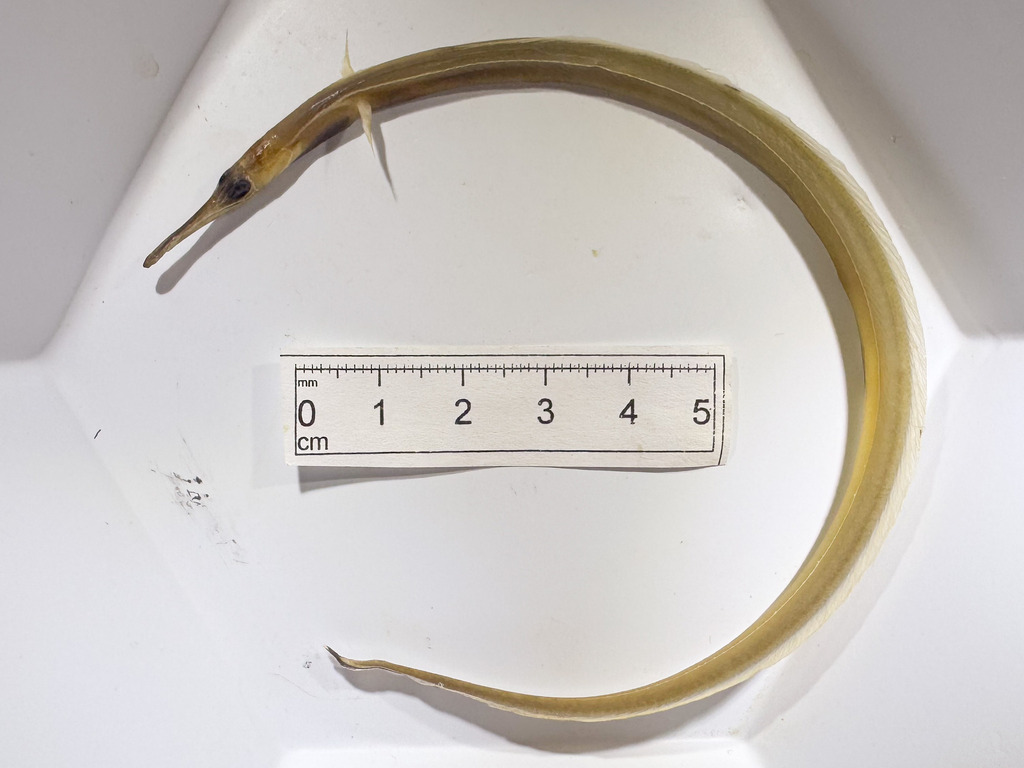
The Duckbill oceanic eel (Nessorhamphus ingolfianus) is a saltwater fish of the family Derichthyidae that grows up to 60 cm.
Description
The duckbill oceanic eel is a snake-like deep-sea eel of the family Derichthyidae reaching about 60 cm. The slender, brownish to silvery body tapers backward and bears a continuous dorsal and anal fin; striking is the long, flattened snout resembling a duck's bill, which gives the species its name. It lives meso- to bathypelagically in the open water of tropical and temperate oceans worldwide, including the Atlantic. Unlike many eels it does not live on the bottom but hovers in the water column, where it hunts small fish and crustaceans. Like all true eels it develops through a transparent, leaf-shaped leptocephalus larva that drifts with the currents for a long time before transforming.
Frequently asked questions
How do you recognise the Duckbill oceanic eel?
The Duckbill oceanic eel has a snake-like body, is mainly brown and shows a plain pattern.
Where does the Duckbill oceanic eel live?
The Duckbill oceanic eel lives in the sea (marine waters) and is mostly found around open water.
How big does the Duckbill oceanic eel get?
The Duckbill oceanic eel grows to a maximum of about 60 cm.
Is the Duckbill oceanic eel dangerous to humans?
No, the Duckbill oceanic eel is harmless to humans.
Is the Duckbill oceanic eel edible?
The Duckbill oceanic eel is not usually eaten.
Download Fin's Fish Guide
Identify fish in seconds, log your catches and dives. Join the TestFlight beta.
All data
Identification
Appearance
Habitat & distribution
Behaviour & biology
For anglers
Safety
Status & sources
Same genus Nessorhamphus

More from the family Derichthyidae

Download Fin's Fish Guide
Identify fish in seconds, log your catches and dives. Join the TestFlight beta.