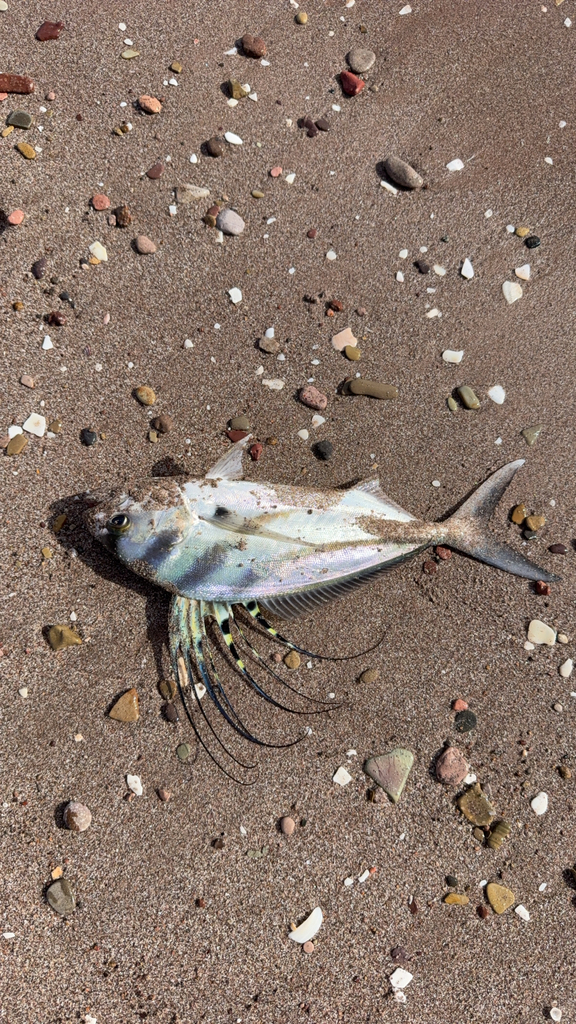
The Jack (Nematistius pectoralis) is a saltwater fish of the family Nematistiidae that grows up to 163 cm.
Description
The roosterfish is a striking coastal fish of the eastern Pacific, the only species of the family Nematistiidae. The species grows to about 1.6 metres and owes its name to the seven greatly elongated, thread-like rays of the first dorsal fin, which can be raised like a rooster's comb. The silvery body bears two dark oblique bands. Adults inhabit shallow coastal waters and sandy beaches, juveniles stay in tide pools. As a fast predator it hunts small fishes. The roosterfish is a highly prized sport fish caught on lures and usually released. It is harmless to humans.
Frequently asked questions
How do you recognise the Jack?
The Jack has a torpedo-shaped body, is mainly silver-grey and shows a vertical stripes pattern.
Where does the Jack live?
The Jack lives in the sea (marine waters) and is mostly found around sand or mud bottom.
How big does the Jack get?
The Jack grows to a maximum of about 163 cm. On average the species is around 60 cm.
Is the Jack dangerous to humans?
No, the Jack is harmless to humans.
Is the Jack edible?
The Jack is rarely eaten.
Download Fin's Fish Guide
Identify fish in seconds, log your catches and dives. Join the TestFlight beta.
All data
Identification
Appearance
Habitat & distribution
Behaviour & biology
For anglers
Safety
Status & sources
Download Fin's Fish Guide
Identify fish in seconds, log your catches and dives. Join the TestFlight beta.