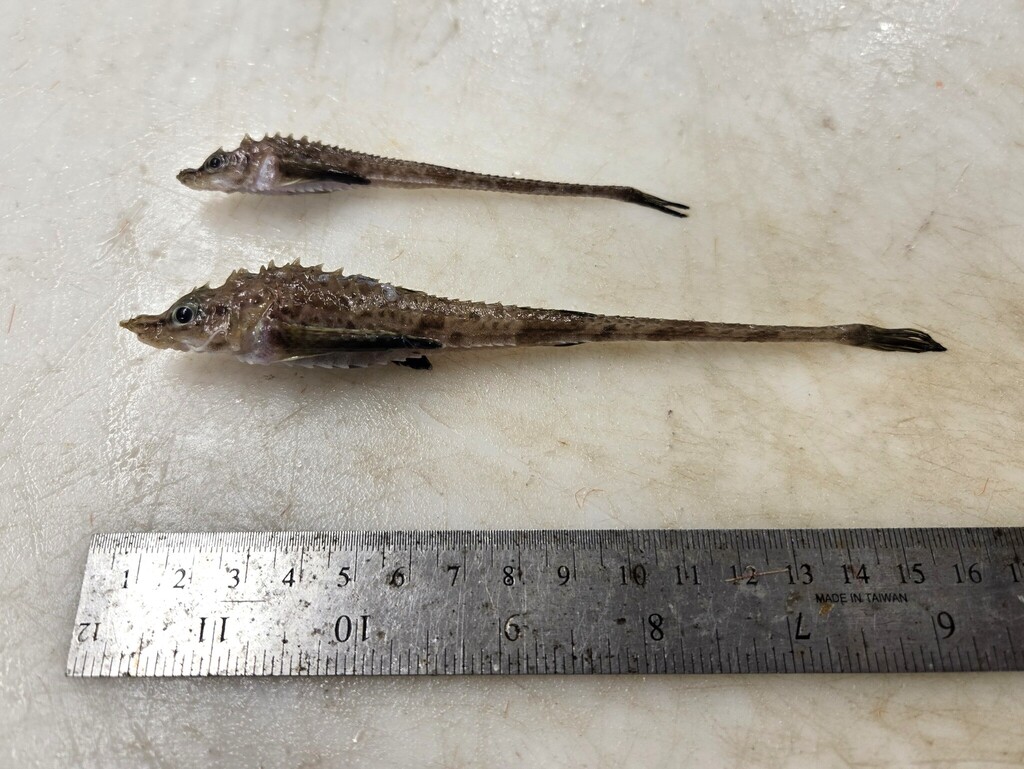
The Atlantic poacher (Leptagonus decagonus) is a saltwater fish of the family Agonidae that grows up to 21 cm.
Description
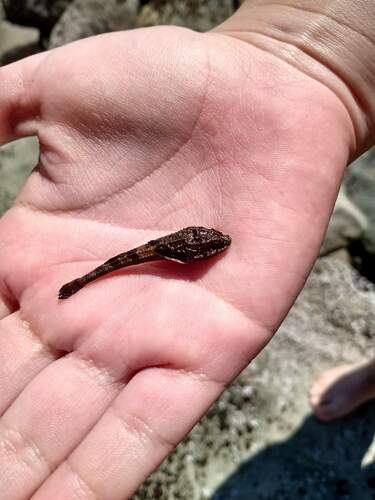
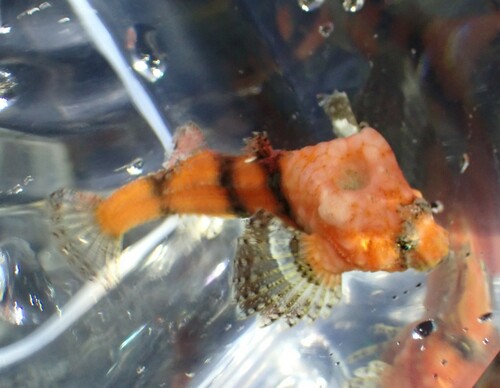
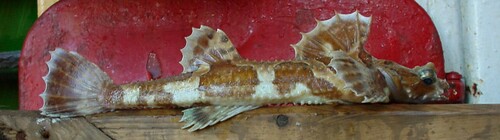
The Atlantic poacher is a small bottom-dwelling fish of the family Agonidae from the cold waters of the northern Atlantic Ocean and the Arctic. The species has an elongate body entirely covered with bony plates and an angular, almost ten-sided cross-section, to which the name refers. It reaches about 21 cm and lives on muddy bottoms at temperatures around freezing. The diet consists of crustaceans and polychaete worms picked from the bottom. Beneath the head the fish bears small barbels. Because of its small size the species has no fishery value.
Frequently asked questions
How do you recognise the Atlantic poacher?
The Atlantic poacher has an elongate, eel-like body, is mainly brown and shows a vertical stripes pattern.
Where does the Atlantic poacher live?
The Atlantic poacher lives in the sea (marine waters) and is mostly found around sand or mud bottom.
How big does the Atlantic poacher get?
The Atlantic poacher grows to a maximum of about 21 cm.
Is the Atlantic poacher dangerous to humans?
No, the Atlantic poacher is harmless to humans.
Is the Atlantic poacher edible?
The Atlantic poacher is not usually eaten.
Download Fin's Fish Guide
Identify fish in seconds, log your catches and dives. Join the TestFlight beta.
All data
Identification
Appearance
Habitat & distribution
Behaviour & biology
For anglers
Safety
Status & sources
More from the family Agonidae

Download Fin's Fish Guide
Identify fish in seconds, log your catches and dives. Join the TestFlight beta.