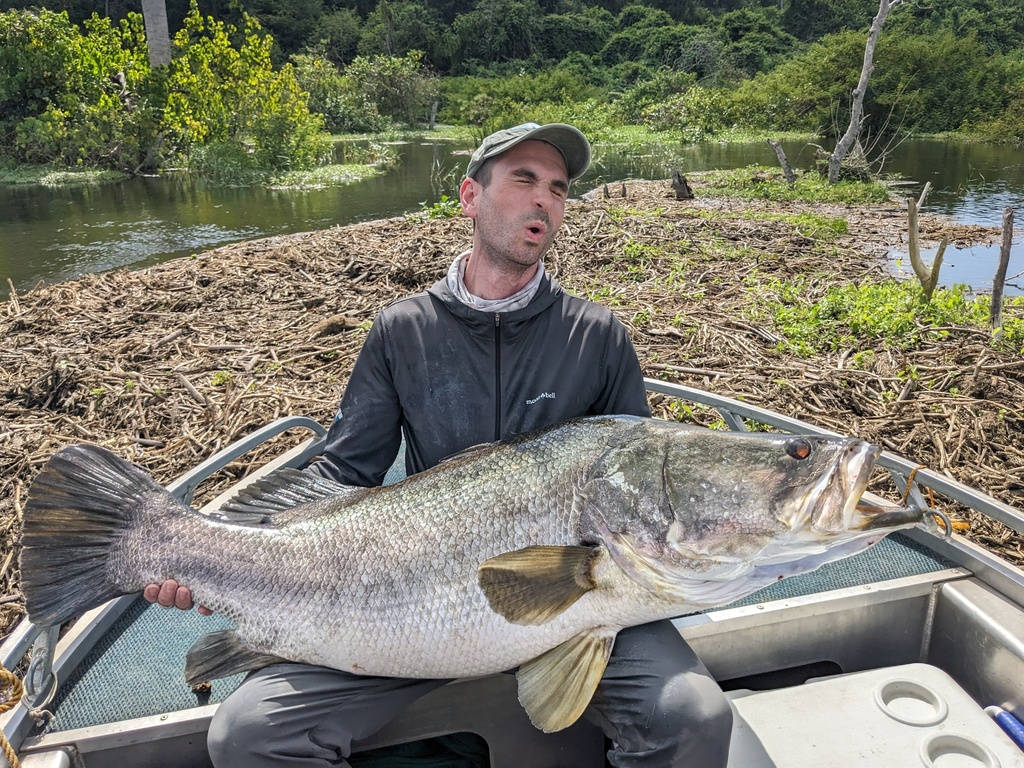
The African snook (Lates niloticus) is a freshwater fish of the family Latidae that grows up to 200 cm.
Description
The Nile perch is a large freshwater predatory fish of the family Latidae native to many African river systems, including the Nile, Congo and Lake Chad. The species has a streamlined, silvery-grey body with a large mouth and can exceptionally reach about 2 m and 200 kg, making it one of Africa's largest freshwater fishes. Adults live in deeper water and prey on fishes, while juveniles eat plankton and invertebrates. The species is highly prized as a food and sport fish, but became notorious after its introduction to Lake Victoria, where it displaced numerous endemic cichlids.
Frequently asked questions
How do you recognise the African snook?
The African snook has a torpedo-shaped body, is mainly silver-grey and shows a plain pattern.
Where does the African snook live?
The African snook lives in fresh water and is mostly found around sand or mud bottom.
How big does the African snook get?
The African snook grows to a maximum of about 200 cm. On average the species is around 100 cm.
Is the African snook dangerous to humans?
No, the African snook is harmless to humans.
Is the African snook edible?
Yes, the African snook is a highly prized food fish.
Download Fin's Fish Guide
Identify fish in seconds, log your catches and dives. Join the TestFlight beta.
All data
Identification
Appearance
Habitat & distribution
Behaviour & biology
For anglers
Safety
Status & sources
Same genus Lates
More from the family Latidae
Download Fin's Fish Guide
Identify fish in seconds, log your catches and dives. Join the TestFlight beta.