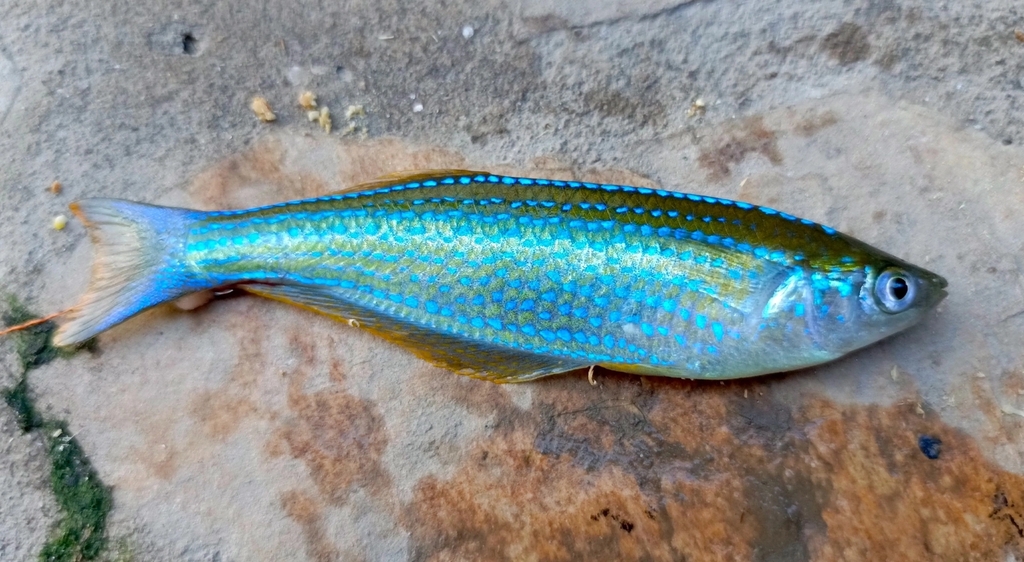
The Tanganyika lampeye (Lamprichthys tanganicanus) is a freshwater fish of the family Poeciliidae that grows up to 15 cm.
Description
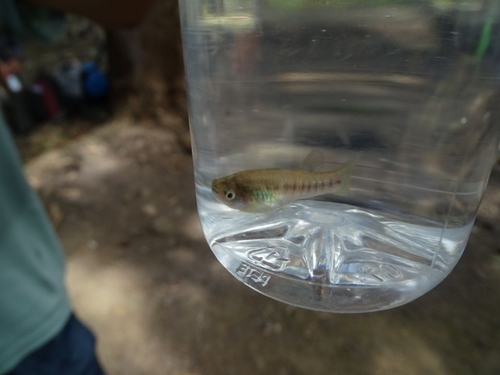
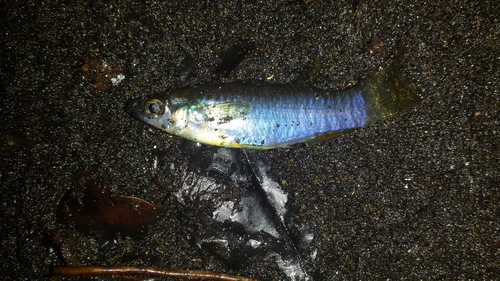
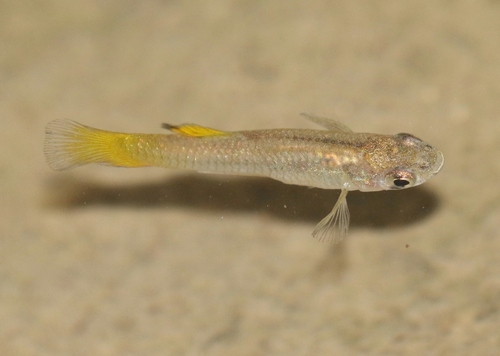
The Tanganyika lampeye is a slender killifish of the family Procatopodidae endemic to Lake Tanganyika in East Africa, reaching about 15 cm - much larger than most killifishes. The body shines blue with rows of glittering blue and yellow spots; males are more vividly coloured than females. The species forms schools in open water over rocky shores of the lake. As an omnivore it eats zooplankton, insects and algae. It lays its eggs on long threads in rock crevices, where the young grow up sheltered. Because of its handsome colours and special origin it is sought after by advanced aquarium keepers, and it is characteristic of the rich fish fauna of Lake Tanganyika.
Frequently asked questions
How do you recognise the Tanganyika lampeye?
The Tanganyika lampeye has an elongate, eel-like body, is mainly blue and shows a spots pattern.
Where does the Tanganyika lampeye live?
The Tanganyika lampeye lives in fresh water and is mostly found around stony or rocky ground.
How big does the Tanganyika lampeye get?
The Tanganyika lampeye grows to a maximum of about 15 cm.
Is the Tanganyika lampeye dangerous to humans?
No, the Tanganyika lampeye is harmless to humans.
Is the Tanganyika lampeye edible?
The Tanganyika lampeye is rarely eaten.
Download Fin's Fish Guide
Identify fish in seconds, log your catches and dives. Join the TestFlight beta.
All data
Identification
Appearance
Habitat & distribution
Behaviour & biology
For anglers
Safety
Status & sources
More from the family Poeciliidae


Download Fin's Fish Guide
Identify fish in seconds, log your catches and dives. Join the TestFlight beta.