
The Roundbelly pellonuline (Laeviscutella dekimpei) is a brackish-water fish of the family Clupeidae that grows up to 6 cm.
Description
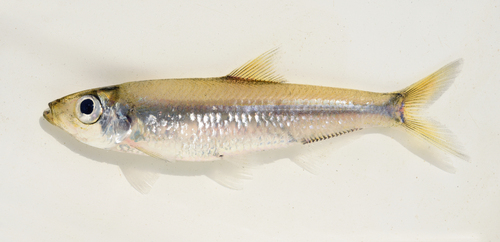
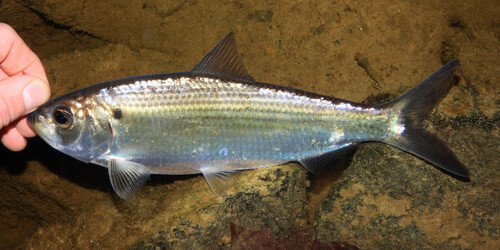
Laeviscutella dekimpei is a very small freshwater herring (family Clupeidae) of West Africa. The species reaches only about 5 cm and has a slender, silvery body with a rounded belly. It is chiefly a riverine species occurring near the coast and entering lagoons, where salinity varies with the tides; it is presumably euryhaline, though it appears to avoid high salinities. As a filter feeder it lives on small zooplankton. It lives in schools and is caught locally in subsistence fisheries. The species is harmless to humans.
Frequently asked questions
How do you recognise the Roundbelly pellonuline?
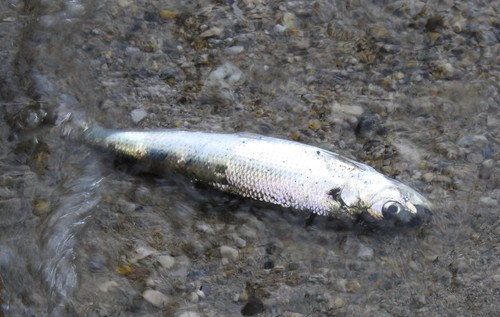
The Roundbelly pellonuline has a torpedo-shaped body, is mainly silver-grey and shows a plain pattern.
Where does the Roundbelly pellonuline live?
The Roundbelly pellonuline lives in brackish water and is mostly found around open water.
How big does the Roundbelly pellonuline get?
The Roundbelly pellonuline grows to a maximum of about 6 cm.
Is the Roundbelly pellonuline dangerous to humans?
No, the Roundbelly pellonuline is harmless to humans.
Is the Roundbelly pellonuline edible?
The Roundbelly pellonuline is rarely eaten.
Download Fin's Fish Guide
Identify fish in seconds, log your catches and dives. Join the TestFlight beta.
All data
Identification
Appearance
Habitat & distribution
Behaviour & biology
For anglers
Safety
Status & sources
More from the family Clupeidae

Download Fin's Fish Guide
Identify fish in seconds, log your catches and dives. Join the TestFlight beta.