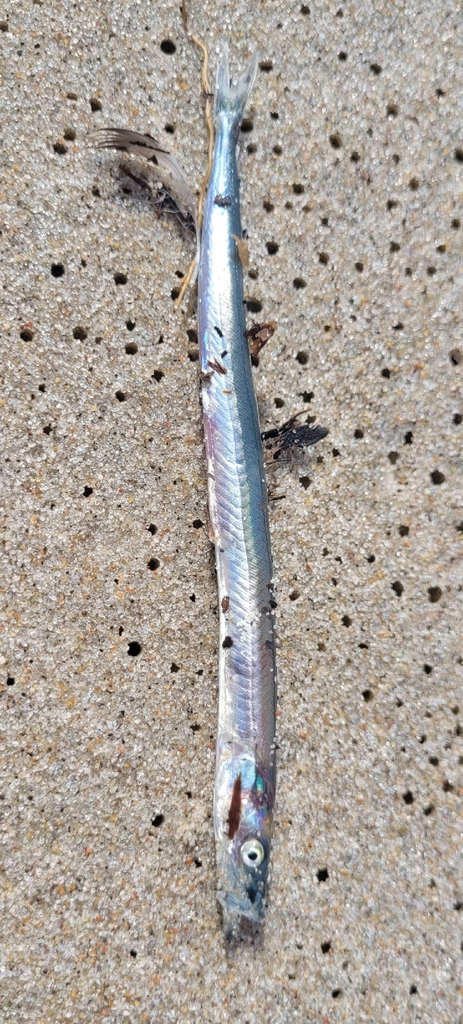
The Greater sandeel (Hyperoplus lanceolatus) is a saltwater fish of the family Ammodytidae that grows up to 40 cm.
Description
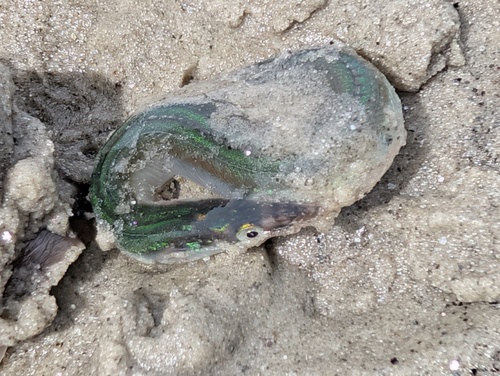
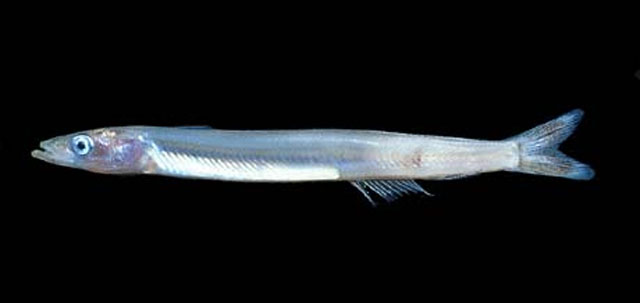
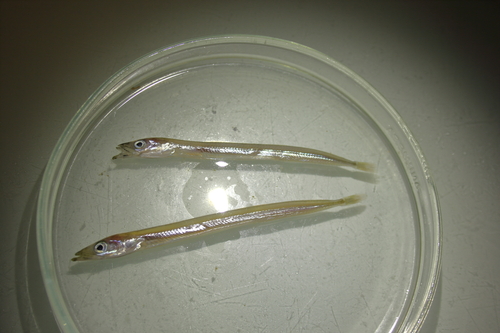
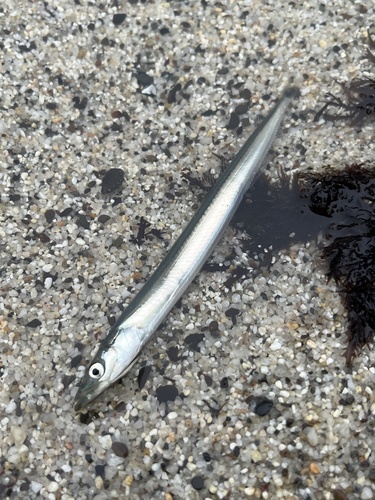
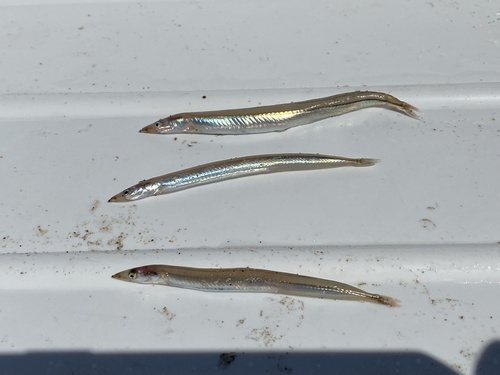
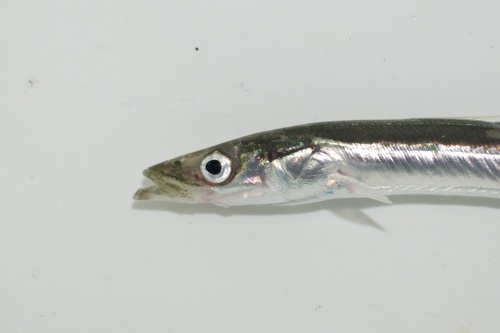
The greater sandeel is a slender, eel-like marine fish of the family Ammodytidae reaching about 40 cm, the largest sandeel of our coast. The streamlined, silvery body has a pointed head, a projecting lower jaw and often a dark spot on the snout. Unlike the smaller sandeels it cannot protrude the upper jaw. The species lives on sandy bottoms in coastal water of the north-eastern Atlantic, the North Sea and the Baltic and forms large schools above sandbanks. It is notable for being able to burrow into the sand at lightning speed. It hunts small fish, fish larvae and zooplankton. Sandeels are crucial food for seabirds, marine mammals and commercial fish.
Frequently asked questions
How do you recognise the Greater sandeel?
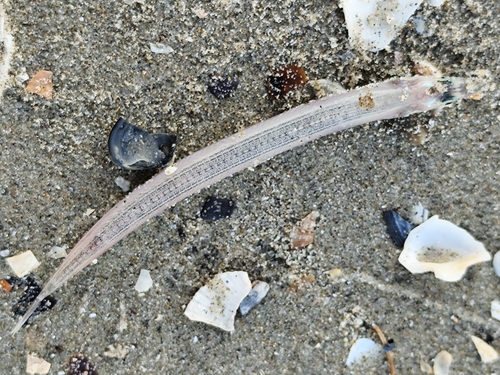
The Greater sandeel has an elongate, eel-like body, is mainly silver-grey and shows a plain pattern.
Where does the Greater sandeel live?
The Greater sandeel lives in the sea (marine waters) and is mostly found around sand or mud bottom.
How big does the Greater sandeel get?
The Greater sandeel grows to a maximum of about 40 cm. On average the species is around 20 cm.
Is the Greater sandeel dangerous to humans?
No, the Greater sandeel is harmless to humans.
Is the Greater sandeel edible?
The Greater sandeel is rarely eaten.
Download Fin's Fish Guide
Identify fish in seconds, log your catches and dives. Join the TestFlight beta.
All data
Identification
Appearance
Habitat & distribution
Behaviour & biology
For anglers
Safety
Status & sources
More from the family Ammodytidae

Download Fin's Fish Guide
Identify fish in seconds, log your catches and dives. Join the TestFlight beta.