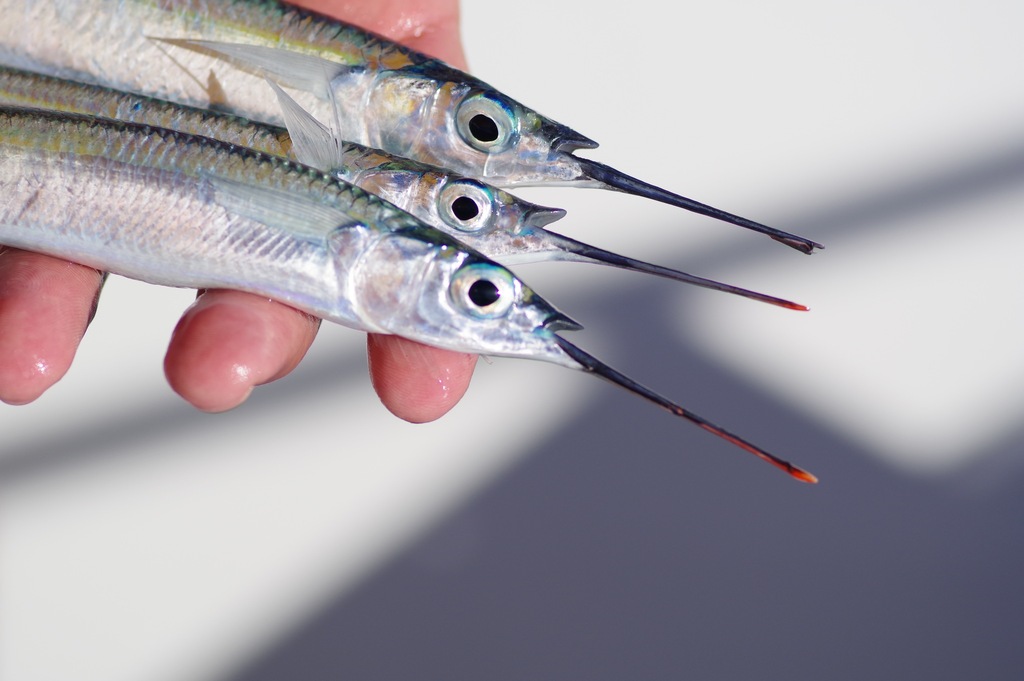
The Ballyhoo halfbeak (Hemiramphus brasiliensis) is a saltwater fish of the family Hemiramphidae that grows up to 55 cm.
Description
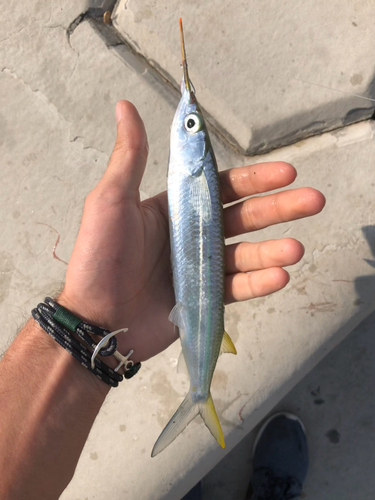
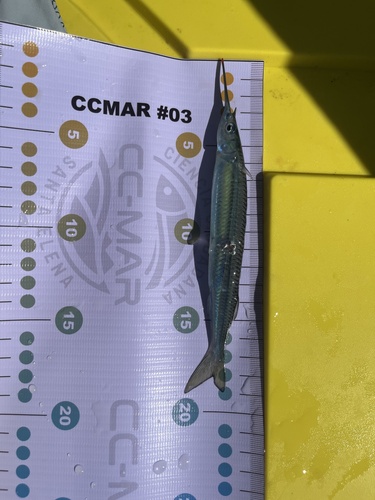
The ballyhoo halfbeak is a slender surface fish of the family Hemiramphidae reaching about 55 cm. It is characterised by the greatly elongated lower jaw projecting like a needle, while the upper jaw is short and triangular; the silvery body has a blue-green back and a forked tail whose lower lobe is larger. The species lives in schools just below the surface in the warmer parts of the Atlantic, including the Caribbean. It grazes on drifting seagrass and algae and takes small zooplankton and insects. Halfbeaks are widely used as bait for sport fishing of large predators and are themselves important prey.
Frequently asked questions
How do you recognise the Ballyhoo halfbeak?
The Ballyhoo halfbeak has an elongate, eel-like body, is mainly silver-grey and shows a plain pattern.
Where does the Ballyhoo halfbeak live?
The Ballyhoo halfbeak lives in the sea (marine waters) and is mostly found around stony or rocky ground.
How big does the Ballyhoo halfbeak get?
The Ballyhoo halfbeak grows to a maximum of about 55 cm. On average the species is around 35 cm.
Is the Ballyhoo halfbeak dangerous to humans?
No, the Ballyhoo halfbeak is harmless to humans.
Is the Ballyhoo halfbeak edible?
The Ballyhoo halfbeak is rarely eaten.
Download Fin's Fish Guide
Identify fish in seconds, log your catches and dives. Join the TestFlight beta.
All data
Identification
Appearance
Habitat & distribution
Behaviour & biology
For anglers
Safety
Status & sources
Same genus Hemiramphus

More from the family Hemiramphidae


Download Fin's Fish Guide
Identify fish in seconds, log your catches and dives. Join the TestFlight beta.