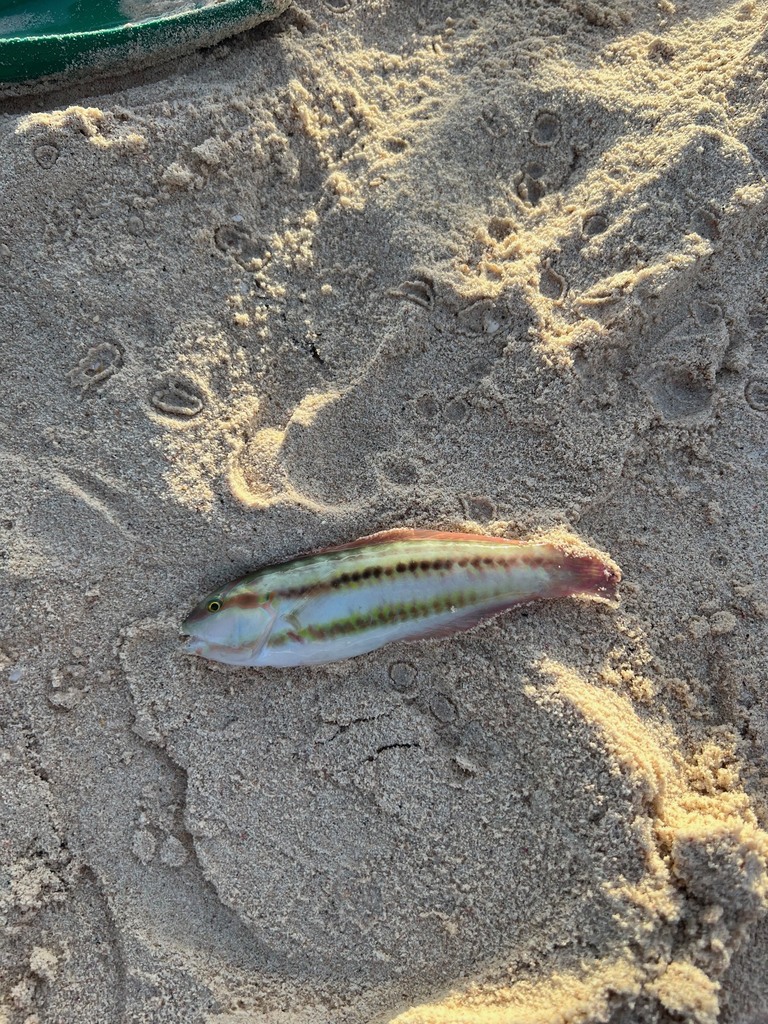
The Slippery dick (Halichoeres bivittatus) is a saltwater fish of the family Labridae that grows up to 35 cm.
Description
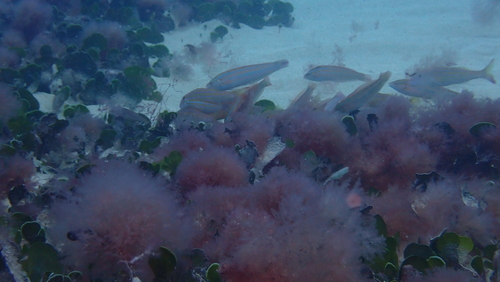
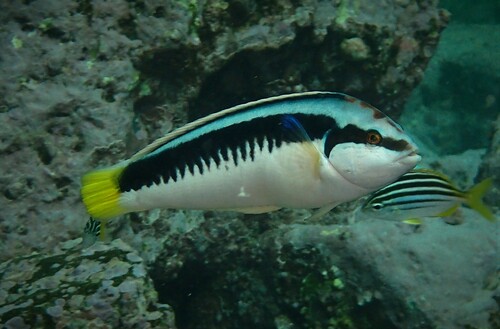
The slippery dick is a slender wrasse of the family Labridae reaching about 35 cm. Two dark lengthwise stripes run along the body; the ground colour varies greatly with age and phase, from greenish and white to pink-purple tints. The species lives on coral and rock reefs, in seagrass and on sand flats of shallow water in the western Atlantic and the Caribbean. On the bottom it hunts snails, crabs, sea urchins, worms and other small bottom animals. At night and when threatened it quickly buries itself in the sand. Like many wrasses it is a protogynous hermaphrodite: animals begin as females and can later change into males.
Frequently asked questions
How do you recognise the Slippery dick?
The Slippery dick has a torpedo-shaped body, is mainly green and shows a horizontal stripes pattern.
Where does the Slippery dick live?
The Slippery dick lives in the sea (marine waters) and is mostly found around stony or rocky ground.
How big does the Slippery dick get?
The Slippery dick grows to a maximum of about 35 cm.
Is the Slippery dick dangerous to humans?
No, the Slippery dick is harmless to humans.
Is the Slippery dick edible?
The Slippery dick is not usually eaten.
Download Fin's Fish Guide
Identify fish in seconds, log your catches and dives. Join the TestFlight beta.
All data
Identification
Appearance
Habitat & distribution
Behaviour & biology
For anglers
Safety
Status & sources
Same genus Halichoeres
More from the family Labridae
Download Fin's Fish Guide
Identify fish in seconds, log your catches and dives. Join the TestFlight beta.