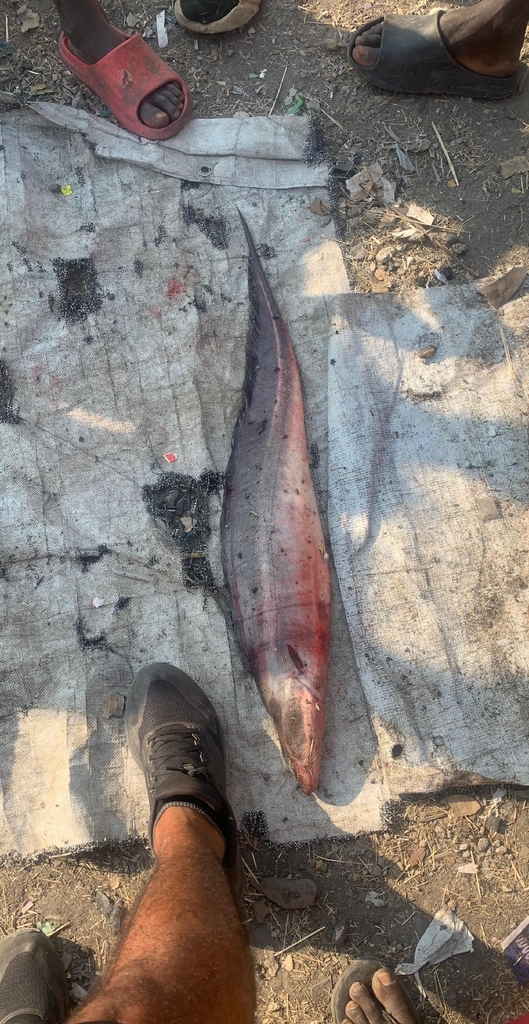
The Aba (Gymnarchus niloticus) is a freshwater fish of the family Gymnarchidae that grows up to 167 cm.
Description
The aba aba is a large, remarkable African freshwater fish, the only species of the family Gymnarchidae, related to the elephantfishes. The species can reach about 1.7 metres and has an elongate, rearward-tapering body without pelvic, anal and caudal fins; propulsion comes from a single long, continuous dorsal fin with which it swims backward as easily as forward. It generates a continuous weak electric field to navigate turbid water and find prey. As an obligate air-breather it gulps air at the surface. During high water it builds a flask-shaped nest in the vegetation. It is an aggressive predator with sharp teeth; keep clear of the mouth.
Frequently asked questions
How do you recognise the Aba?
The Aba has an elongate, eel-like body, is mainly brown and shows a plain pattern.
Where does the Aba live?
The Aba lives in fresh water and is mostly found around sand or mud bottom.
How big does the Aba get?
The Aba grows to a maximum of about 167 cm.
Is the Aba dangerous to humans?
No, the Aba is harmless to humans.
Is the Aba edible?
Yes, the Aba is commonly eaten.
Download Fin's Fish Guide
Identify fish in seconds, log your catches and dives. Join the TestFlight beta.
All data
Identification
Appearance
Habitat & distribution
Behaviour & biology
For anglers
Safety
Status & sources
Download Fin's Fish Guide
Identify fish in seconds, log your catches and dives. Join the TestFlight beta.