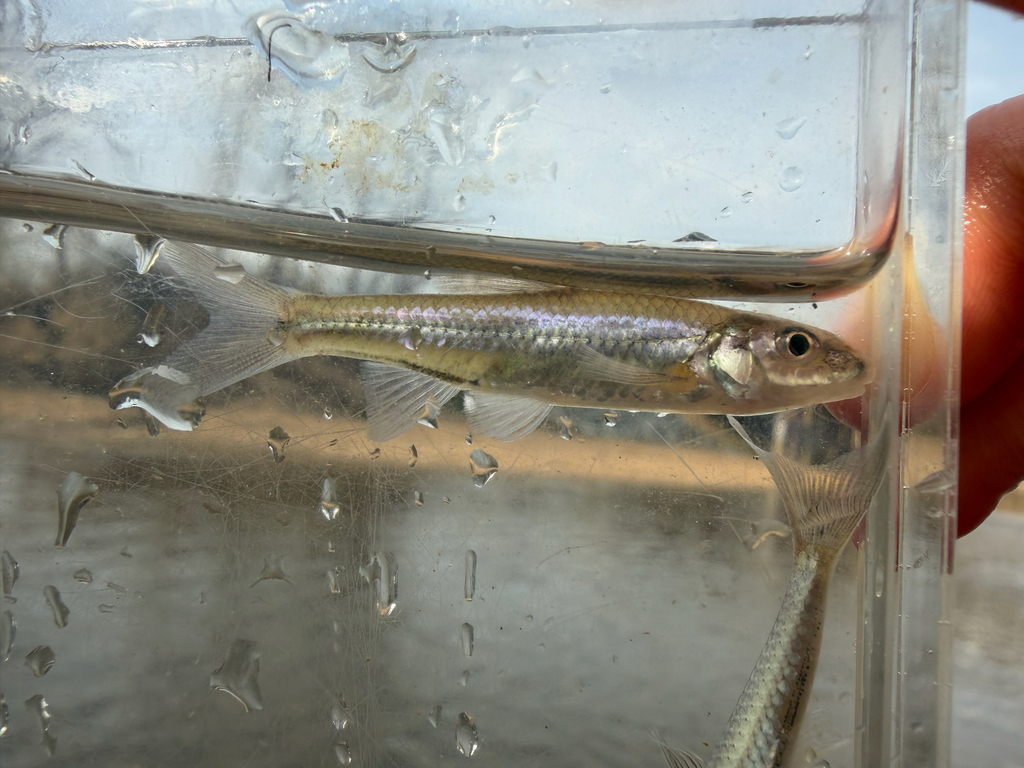
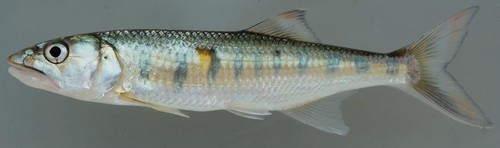
The Silverjaw minnow (Ericymba buccata) is a freshwater fish of the family Cyprinidae that grows up to 10 cm.
Description
The silverjaw minnow is a small North American minnow (family Leuciscidae). The species reaches about 10 cm and has a slender, silvery body with conspicuous, cavity-filled silvery cheek bones that are part of an extensive sensory canal system. It inhabits shallow sandy riffles and raceways of creeks and small to medium rivers. Its diet consists of small crustaceans such as water fleas and copepods, and at night also midge larvae. The species lives in schools and is harmless to humans; because of its small size it is of no fishery value.
Frequently asked questions
How do you recognise the Silverjaw minnow?
The Silverjaw minnow has a torpedo-shaped body, is mainly silver-grey and shows a plain pattern.
Where does the Silverjaw minnow live?
The Silverjaw minnow lives in fresh water and is mostly found around sand or mud bottom.
How big does the Silverjaw minnow get?
The Silverjaw minnow grows to a maximum of about 10 cm. On average the species is around 4 cm.
Is the Silverjaw minnow dangerous to humans?
No, the Silverjaw minnow is harmless to humans.
Is the Silverjaw minnow edible?
The Silverjaw minnow is not usually eaten.
Download Fin's Fish Guide
Identify fish in seconds, log your catches and dives. Join the TestFlight beta.
All data
Identification
Appearance
Habitat & distribution
Behaviour & biology
For anglers
Safety
Status & sources
More from the family Cyprinidae


Download Fin's Fish Guide
Identify fish in seconds, log your catches and dives. Join the TestFlight beta.