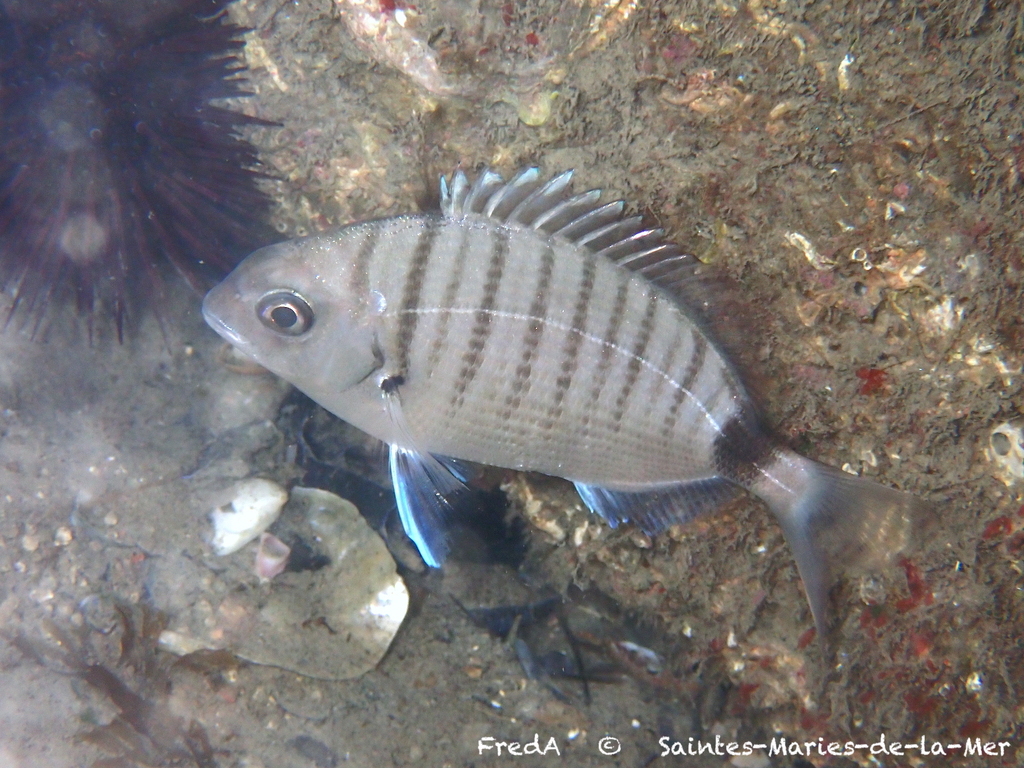
The White seabream (Diplodus sargus) is a brackish-water fish of the family Sparidae that grows up to 45 cm.
Description
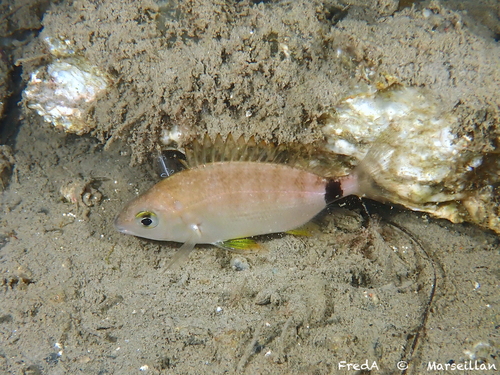
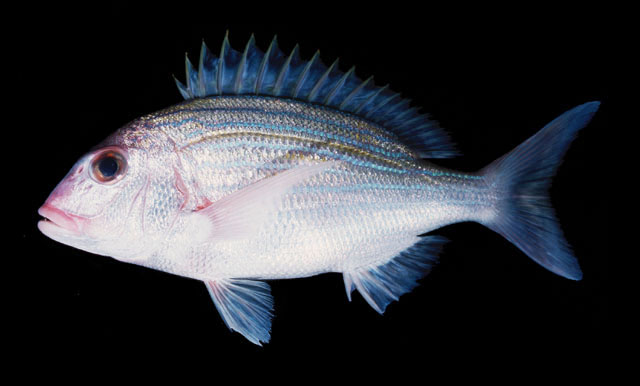
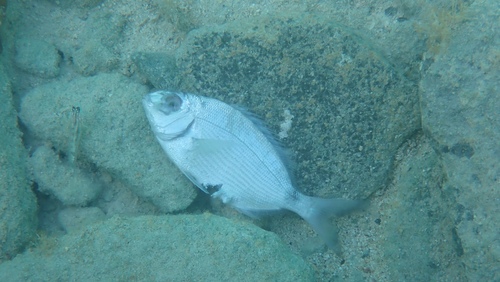
The white seabream is a deep, silvery-grey sea bream of the family Sparidae reaching about 45 cm. The oval, laterally compressed body bears several narrow dark cross-bars and a conspicuous black spot on the tail base. The mouth has flat incisors at the front and molar-like teeth at the back, suited to crushing shellfish and sea urchins. The species forms schools over rocks, sandy bottoms and in the surf of the eastern Atlantic and the Mediterranean, usually in shallow water. It is an omnivore eating worms, shellfish, crustaceans and algae. Like many sea breams it is a protandrous hermaphrodite. The white seabream is a popular and valued sport and food fish.
Frequently asked questions
How do you recognise the White seabream?
The White seabream has a torpedo-shaped body, is mainly silver-grey and shows a vertical stripes pattern.
Where does the White seabream live?
The White seabream lives in brackish water and is mostly found around sand or mud bottom.
How big does the White seabream get?
The White seabream grows to a maximum of about 45 cm. On average the species is around 22 cm.
Is the White seabream dangerous to humans?
No, the White seabream is harmless to humans.
Is the White seabream edible?
Yes, the White seabream is commonly eaten.
Download Fin's Fish Guide
Identify fish in seconds, log your catches and dives. Join the TestFlight beta.
All data
Identification
Appearance
Habitat & distribution
Behaviour & biology
For anglers
Safety
Status & sources
Same genus Diplodus

More from the family Sparidae



Download Fin's Fish Guide
Identify fish in seconds, log your catches and dives. Join the TestFlight beta.