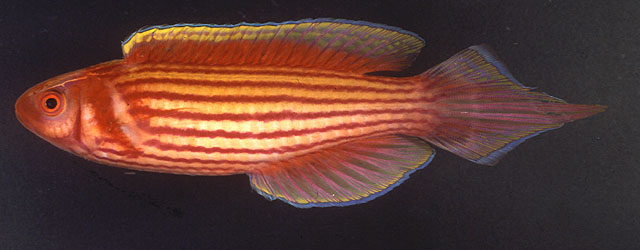
The Finless fairy wrasse (Conniella apterygia) is a saltwater fish of the family Labridae that grows up to 8 cm.
Description
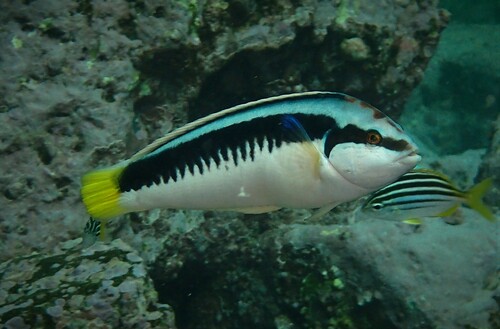
The finless fairy wrasse is a fairy wrasse (Labridae) from reef water of the remote Rowley Shoals off northwestern Australia. The species grows to about 6 cm and has a slender, red-pink to orange body; remarkably it entirely lacks the pelvic fins and their supporting girdle. As a day-active fish it hovers in small groups above coral and rubble slopes and snaps at small zooplankton in the current. Like many wrasses a female can change sex. The fish is harmless to humans.
Frequently asked questions
How do you recognise the Finless fairy wrasse?
The Finless fairy wrasse has an elongate, eel-like body and is mainly red-orange.
Where does the Finless fairy wrasse live?
The Finless fairy wrasse lives in the sea (marine waters) and is mostly found around stony or rocky ground.
How big does the Finless fairy wrasse get?
The Finless fairy wrasse grows to a maximum of about 8 cm.
Is the Finless fairy wrasse dangerous to humans?
No, the Finless fairy wrasse is harmless to humans.
Download Fin's Fish Guide
Identify fish in seconds, log your catches and dives. Join the TestFlight beta.
All data
Identification
Appearance
Habitat & distribution
Behaviour & biology
For anglers
Safety
Status & sources
More from the family Labridae
Download Fin's Fish Guide
Identify fish in seconds, log your catches and dives. Join the TestFlight beta.