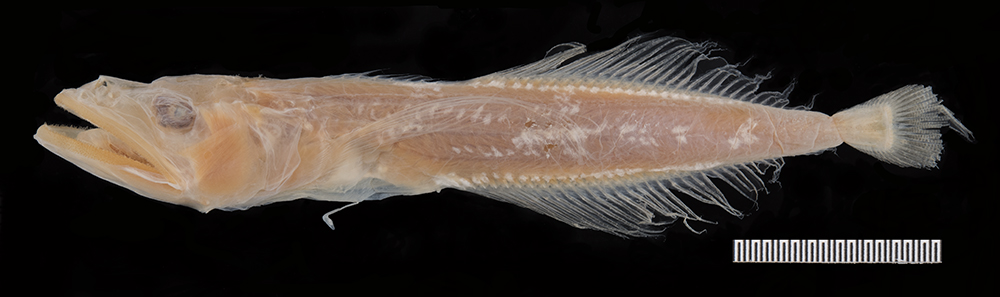
The Big Baikal oilfish (Comephorus baikalensis) is a freshwater fish of the family Comephoridae that grows up to 21 cm.
Description
The big Baikal oilfish is a translucent, scaleless fish of the family Comephoridae reaching about 21 cm and endemic to Lake Baikal; it is the larger of the two oilfishes. The pinkish-white, fat-rich body has enormous, wing-like pectoral fins, large eyes and no swim bladder, adaptations to a drifting life in the open, deep water. The species shuttles daily between shallow and deep layers of the cold, oxygen-rich lake and feeds on small zooplankton and on fish larvae, including those of its own species. Unlike most bony fish it bears live young. The oilfishes form an important link in Baikal's food web and are a main prey of the Baikal seal (nerpa).
Frequently asked questions
How do you recognise the Big Baikal oilfish?
The Big Baikal oilfish has an elongate, eel-like body, is mainly pink-purple and shows a plain pattern.
Where does the Big Baikal oilfish live?
The Big Baikal oilfish lives in fresh water and is mostly found around open water.
How big does the Big Baikal oilfish get?
The Big Baikal oilfish grows to a maximum of about 21 cm.
Is the Big Baikal oilfish dangerous to humans?
No, the Big Baikal oilfish is harmless to humans.
Is the Big Baikal oilfish edible?
The Big Baikal oilfish is not usually eaten.
Download Fin's Fish Guide
Identify fish in seconds, log your catches and dives. Join the TestFlight beta.
All data
Identification
Appearance
Habitat & distribution
Behaviour & biology
For anglers
Safety
Status & sources
Same genus Comephorus
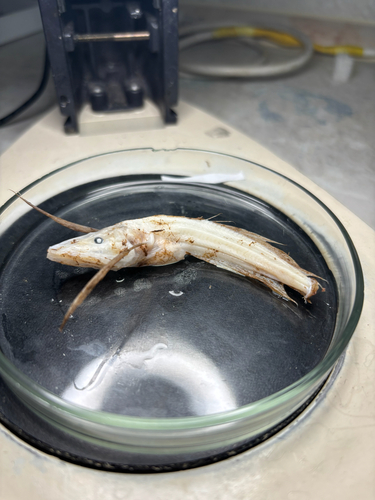
More from the family Comephoridae
Download Fin's Fish Guide
Identify fish in seconds, log your catches and dives. Join the TestFlight beta.