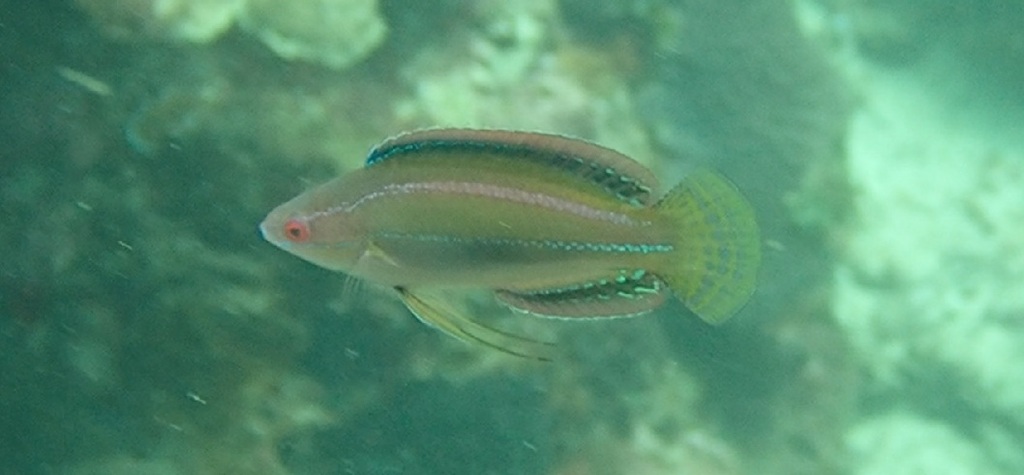
The Blue-stripe flasher (Cirrhilabrus temminckii) is a saltwater fish of the family Labridae that grows up to 10 cm.
Description
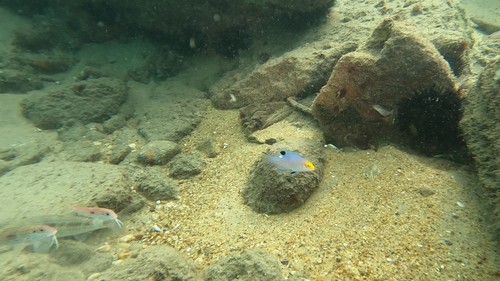
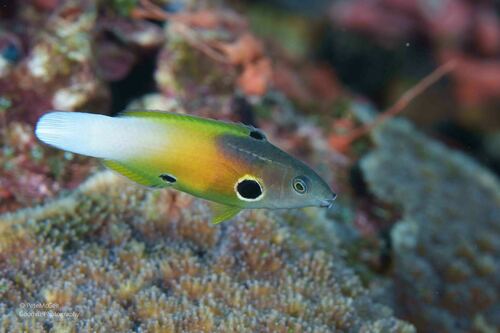
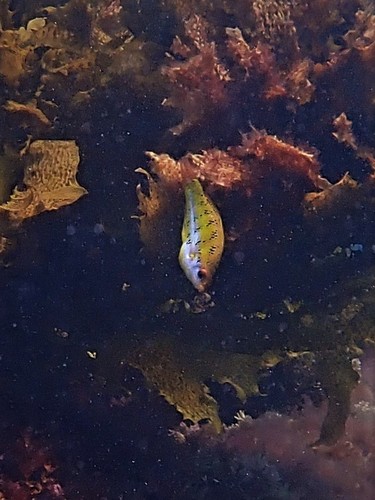
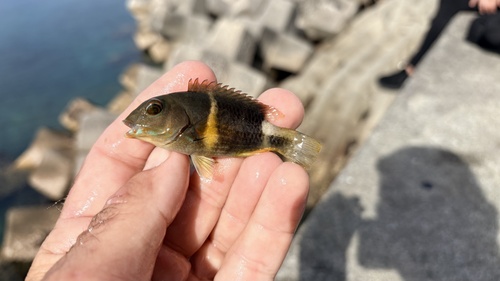
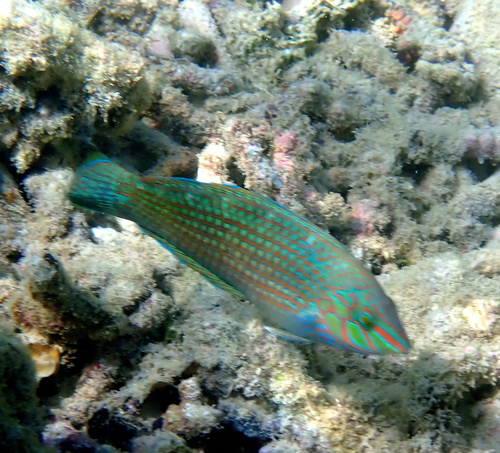
Temminck's threadfin wrasse is a small, colourful wrasse from the western Pacific, ranging from Japan's Sagami Bay to the Philippines and northern Australia. It grows to about 10 cm. Males are vividly coloured with red, pink and blue tones and longitudinal stripes, while females are duller. It lives on reefs with loose rubble between 3 and 35 metres depth and forms aggregations to feed on zooplankton. Like many wrasses the species is probably a protogynous hermaphrodite. The fish is popular in the marine aquarium trade. Owing to insufficient data the IUCN lists the species as Data Deficient (DD).
Frequently asked questions
How do you recognise the Blue-stripe flasher?
The Blue-stripe flasher has a torpedo-shaped body, is mainly multicoloured and shows a horizontal stripes pattern.
Where does the Blue-stripe flasher live?
The Blue-stripe flasher lives in the sea (marine waters) and is mostly found around stony or rocky ground.
How big does the Blue-stripe flasher get?
The Blue-stripe flasher grows to a maximum of about 10 cm.
Is the Blue-stripe flasher dangerous to humans?
No, the Blue-stripe flasher is harmless to humans.
Is the Blue-stripe flasher edible?
The Blue-stripe flasher is not usually eaten.
Download Fin's Fish Guide
Identify fish in seconds, log your catches and dives. Join the TestFlight beta.
All data
Identification
Appearance
Habitat & distribution
Behaviour & biology
For anglers
Safety
Status & sources
Same genus Cirrhilabrus
More from the family Labridae
Download Fin's Fish Guide
Identify fish in seconds, log your catches and dives. Join the TestFlight beta.