
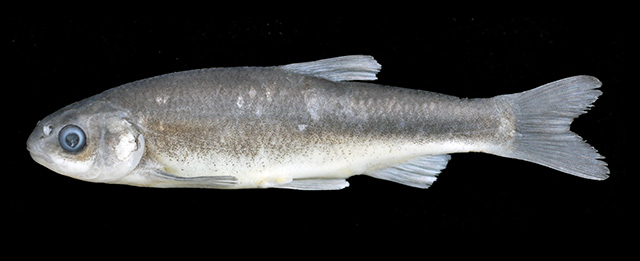
The Minnow-nase (Chondrostoma phoxinus) is a freshwater fish of the family Cyprinidae that grows up to 16 cm.
Description
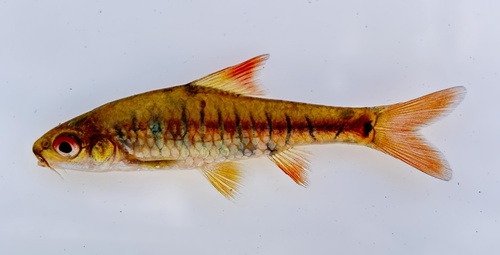
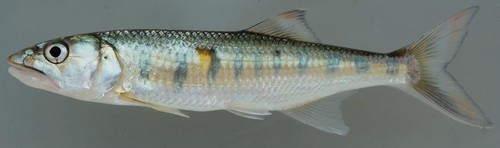
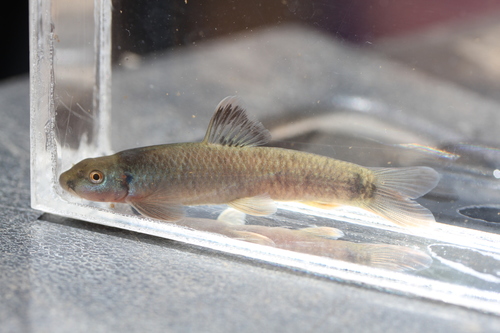
The minnow-nase is a small, slender cyprinid of the family Cyprinidae (Leuciscidae) reaching about 15 cm, much smaller than other nases, which makes it resemble a minnow. The silvery-grey body bears a dark lengthwise stripe; the inferior mouth has a straight, horny cutting edge with which the fish scrapes algae off stones. The species is endemic to the Neretva drainage of the Dinaric karst in Croatia and Bosnia and Herzegovina, in clear, fast-flowing karst water with gravel and stone bottoms. In schools it grazes the algal growth (aufwuchs) off the stones. In spring it migrates upstream to spawn on gravel. Through its very limited range, water pollution and dams it has declined sharply and is assessed as Endangered (EN).
Frequently asked questions
How do you recognise the Minnow-nase?
The Minnow-nase has an elongate, eel-like body, is mainly silver-grey and shows a horizontal stripes pattern.
Where does the Minnow-nase live?
The Minnow-nase lives in fresh water and is mostly found around sand or mud bottom.
How big does the Minnow-nase get?
The Minnow-nase grows to a maximum of about 16 cm.
Is the Minnow-nase dangerous to humans?
No, the Minnow-nase is harmless to humans.
Is the Minnow-nase edible?
The Minnow-nase is not usually eaten.
Download Fin's Fish Guide
Identify fish in seconds, log your catches and dives. Join the TestFlight beta.
All data
Identification
Appearance
Habitat & distribution
Behaviour & biology
For anglers
Safety
Status & sources
Same genus Chondrostoma




More from the family Cyprinidae


Download Fin's Fish Guide
Identify fish in seconds, log your catches and dives. Join the TestFlight beta.