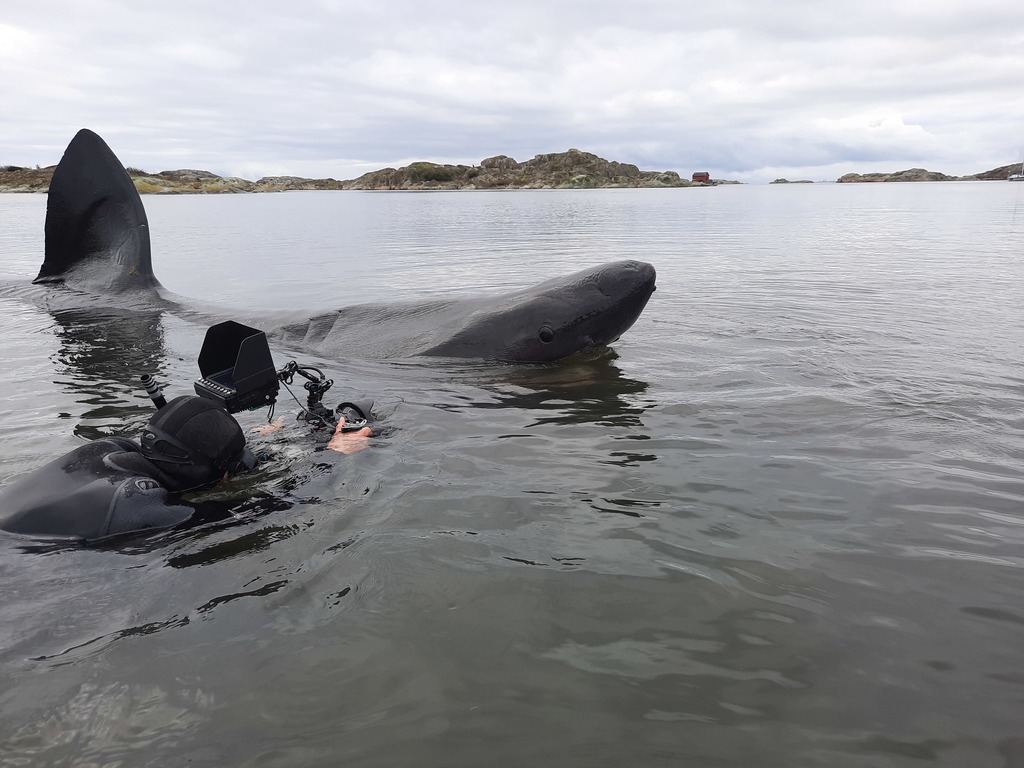
The Basking shark (Cetorhinus maximus) is a saltwater fish of the family Cetorhinidae that grows up to 1520 cm.
Description
The basking shark is, after the whale shark, the largest fish in the world; this shark of the family Cetorhinidae reaches over 10 metres. The grey-brown, torpedo-shaped body has a pointed snout, a crescent tail and very long gill slits that almost encircle the head. Despite its size the basking shark is a harmless, slow filter feeder: it swims with its mouth wide open and sieves zooplankton, mainly copepods, from the water with its gill rakers. The species occurs in temperate coastal and ocean waters worldwide, including the north-eastern Atlantic and the Mediterranean, and is often seen at the surface in spring and summer. Through slow reproduction and past hunting for its liver oil it is assessed as Endangered (EN) and is protected.
Frequently asked questions
How do you recognise the Basking shark?
The Basking shark has an elongate, eel-like body, is mainly brown and shows a plain pattern.
Where does the Basking shark live?
The Basking shark lives in the sea (marine waters) and is mostly found around open water.
How big does the Basking shark get?
The Basking shark grows to a maximum of about 1520 cm. On average the species is around 700 cm.
Is the Basking shark dangerous to humans?
No, the Basking shark is harmless to humans.
Is the Basking shark edible?
The Basking shark is not usually eaten.
Download Fin's Fish Guide
Identify fish in seconds, log your catches and dives. Join the TestFlight beta.
All data
Identification
Appearance
Habitat & distribution
Behaviour & biology
For anglers
Safety
Status & sources
Download Fin's Fish Guide
Identify fish in seconds, log your catches and dives. Join the TestFlight beta.