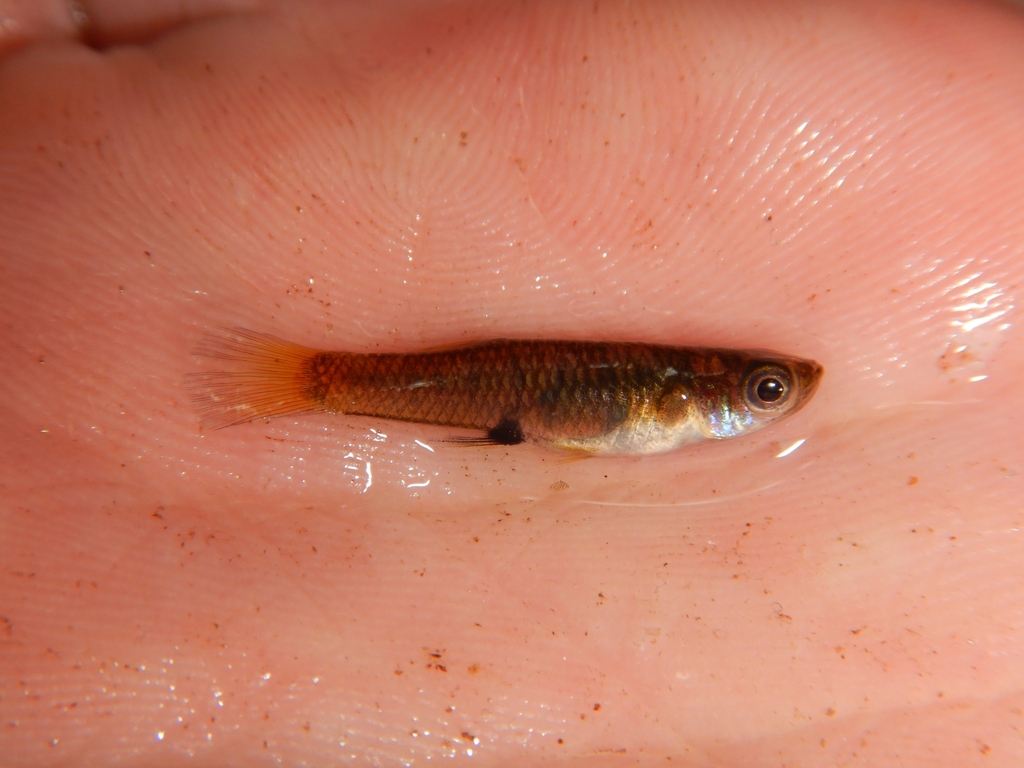
The Bishop toothcarp (Brachyrhaphis episcopi) is a freshwater fish of the family Poeciliidae that grows up to 4 cm.
Description
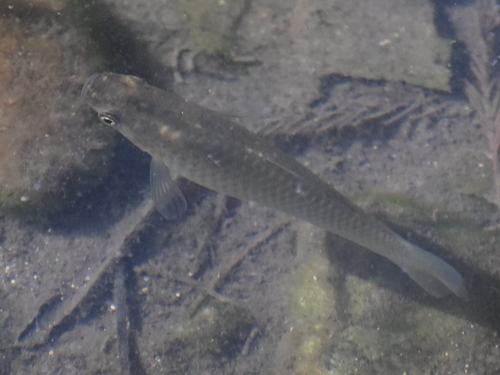
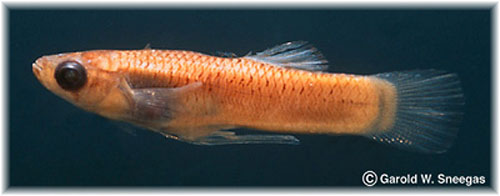
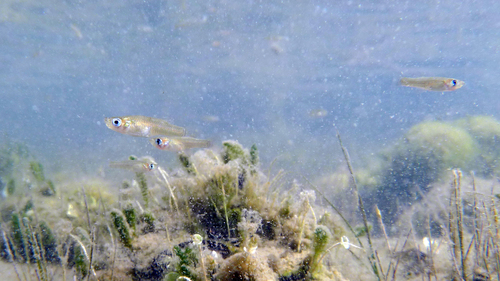
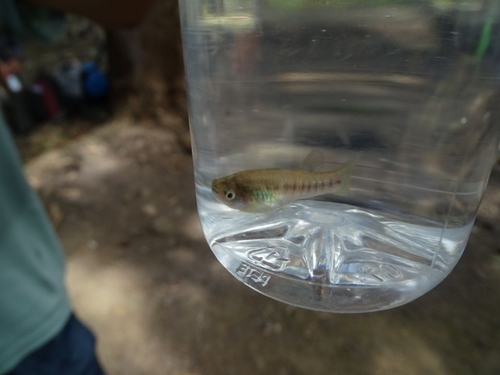
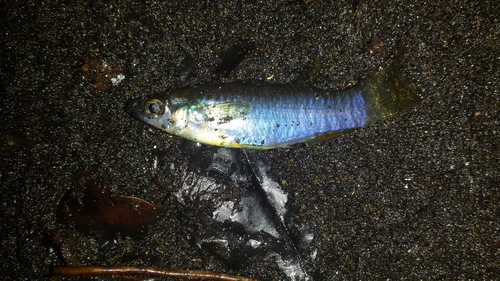
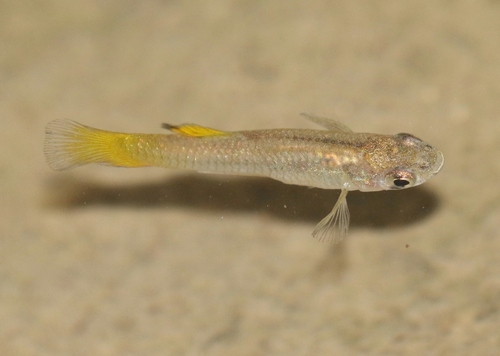
The bishop is a small livebearing fish of the family Poeciliidae from Panama, where it occurs on both the Atlantic and Pacific slopes. The species reaches only about 3.5 cm and has an olive body with dark markings; males and females differ in shape and colour. It inhabits calm zones of flowing waters, standing waters, marshes and other shallow areas. As an omnivore it eats insects, small invertebrates, algae and detritus. Fertilisation is internal and the female bears live young. The species is a favoured model organism for research into predation pressure.
Frequently asked questions
How do you recognise the Bishop toothcarp?
The Bishop toothcarp has a torpedo-shaped body, is mainly brown and shows a vertical stripes pattern.
Where does the Bishop toothcarp live?
The Bishop toothcarp lives in fresh water and is mostly found around open water.
How big does the Bishop toothcarp get?
The Bishop toothcarp grows to a maximum of about 4 cm. On average the species is around 3 cm.
Is the Bishop toothcarp dangerous to humans?
No, the Bishop toothcarp is harmless to humans.
Is the Bishop toothcarp edible?
The Bishop toothcarp is not usually eaten.
Download Fin's Fish Guide
Identify fish in seconds, log your catches and dives. Join the TestFlight beta.
All data
Identification
Appearance
Habitat & distribution
Behaviour & biology
For anglers
Safety
Status & sources
Same genus Brachyrhaphis
More from the family Poeciliidae


Download Fin's Fish Guide
Identify fish in seconds, log your catches and dives. Join the TestFlight beta.