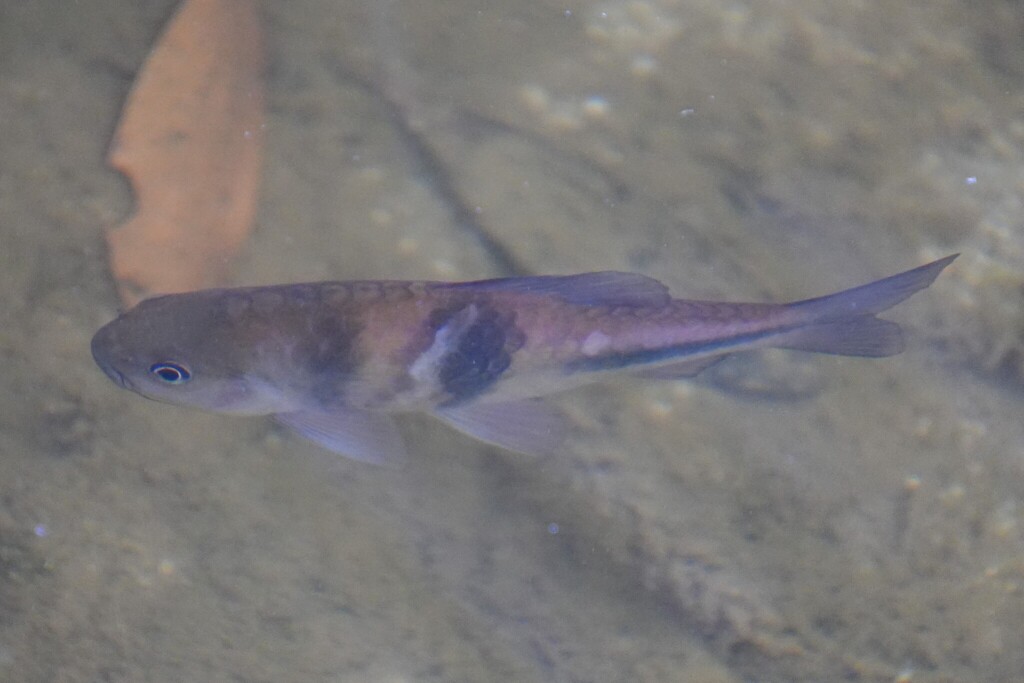
The Spanner barb (Barbodes lateristriga) is a freshwater fish of the family Cyprinidae that grows up to 19 cm.
Description
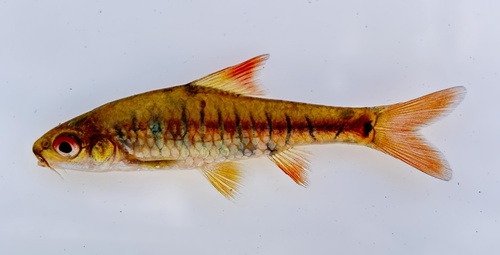
The spanner barb is a cyprinid from Southeast Asia, from the Malay Peninsula to Borneo. The species grows to about 19 cm and has a silvery body with a few dark cross-bars at the front that together resemble a spanner, from which the species takes its name. It lives in clear mountain streams with stones and boulders, often below waterfalls, and is an omnivore eating worms, crustaceans, insects and plant matter. The fish is harmless to humans, popular in the aquarium trade and assessed as Least Concern (LC) by the IUCN.
Frequently asked questions
How do you recognise the Spanner barb?
The Spanner barb has a torpedo-shaped body, is mainly silver-grey and shows a vertical stripes pattern.
Where does the Spanner barb live?
The Spanner barb lives in fresh water and is mostly found around stony or rocky ground.
How big does the Spanner barb get?
The Spanner barb grows to a maximum of about 19 cm.
Is the Spanner barb dangerous to humans?
No, the Spanner barb is harmless to humans.
Is the Spanner barb edible?
The Spanner barb is rarely eaten.
Download Fin's Fish Guide
Identify fish in seconds, log your catches and dives. Join the TestFlight beta.
All data
Identification
Appearance
Habitat & distribution
Behaviour & biology
For anglers
Safety
Status & sources
Same genus Barbodes

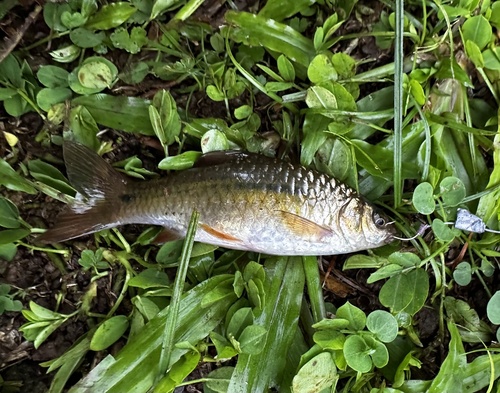
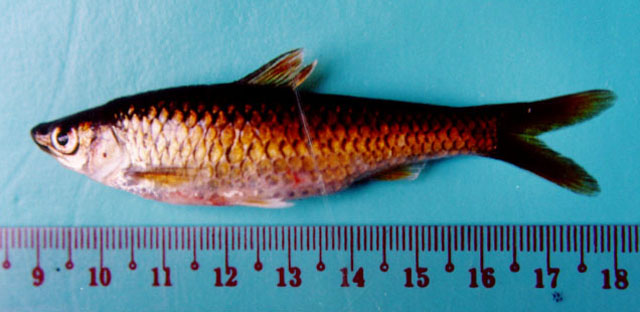
More from the family Cyprinidae

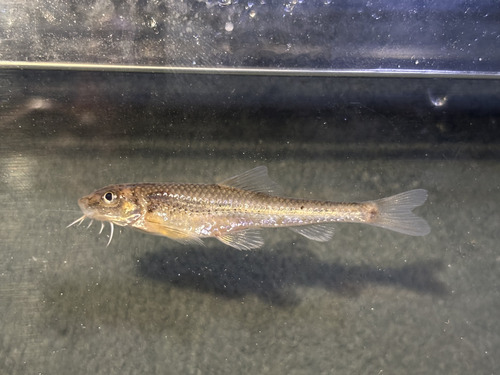
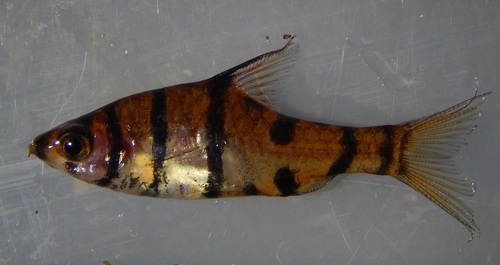

Download Fin's Fish Guide
Identify fish in seconds, log your catches and dives. Join the TestFlight beta.