
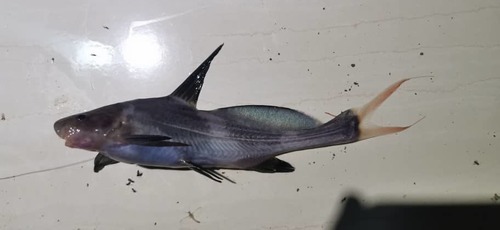
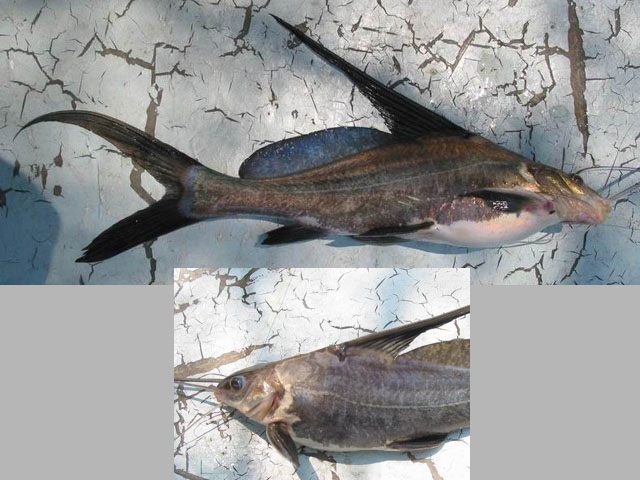
The Black lancer catfish (Bagrichthys hypselopterus) is a freshwater fish of the family Bagridae that grows up to 40 cm.
Description
The black lancer catfish is a bagrid catfish (Bagridae) from fresh water of Sumatra and Borneo in Southeast Asia. The species grows to about 40 cm and has a slender, velvety-black, scaleless body with a strikingly high, sail-like dorsal fin, long barbels and a deeply forked tail. As a nocturnal bottom-dweller it shelters by day among roots and wood and searches for worms, insect larvae and detritus at night. The fish is harmless to humans and is known from the aquarium trade.
Frequently asked questions
How do you recognise the Black lancer catfish?
The Black lancer catfish has a torpedo-shaped body and is mainly black.
Where does the Black lancer catfish live?
The Black lancer catfish lives in fresh water and is mostly found around sand or mud bottom.
How big does the Black lancer catfish get?
The Black lancer catfish grows to a maximum of about 40 cm.
Is the Black lancer catfish dangerous to humans?
No, the Black lancer catfish is harmless to humans.
Is the Black lancer catfish edible?
Yes, the Black lancer catfish is commonly eaten.
Download Fin's Fish Guide
Identify fish in seconds, log your catches and dives. Join the TestFlight beta.
All data
Identification
Appearance
Habitat & distribution
Behaviour & biology
For anglers
Safety
Status & sources
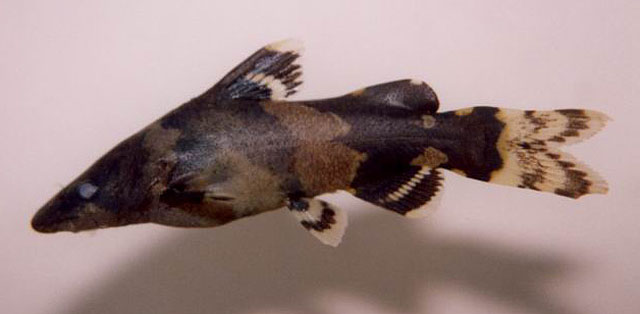
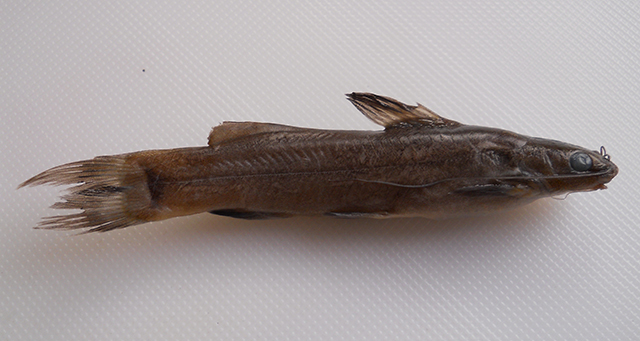
Same genus Bagrichthys
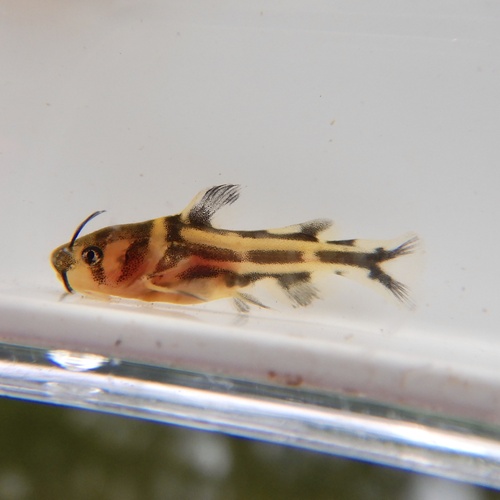
More from the family Bagridae

Download Fin's Fish Guide
Identify fish in seconds, log your catches and dives. Join the TestFlight beta.