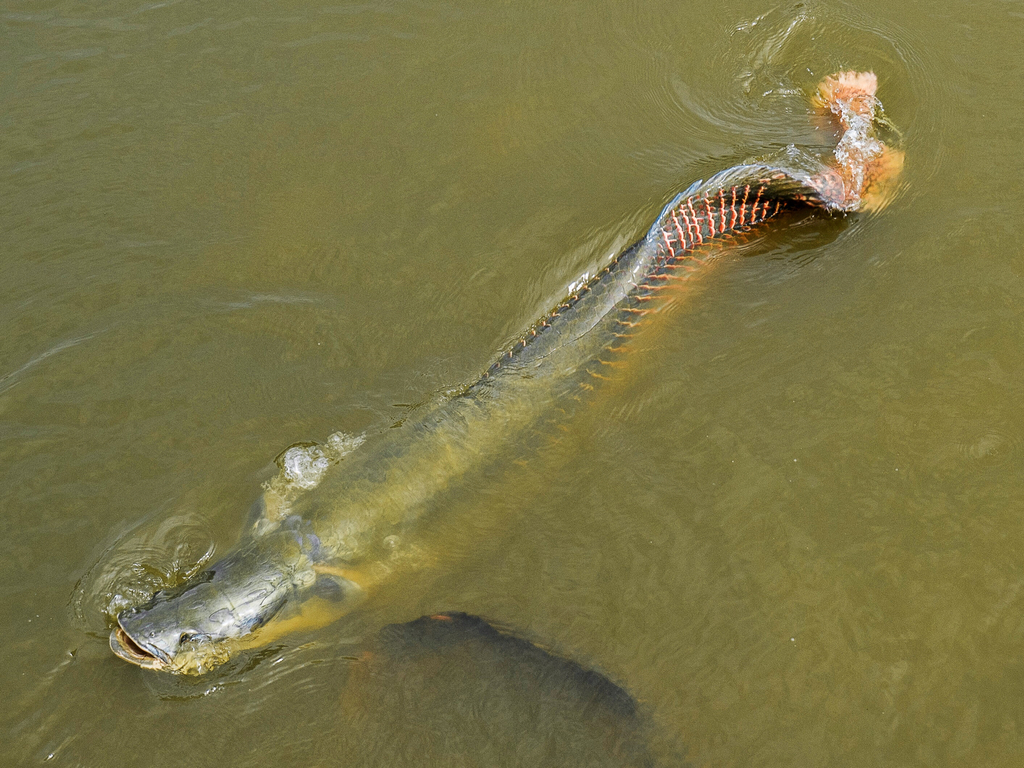
The Arapaima (Arapaima gigas) is a freshwater fish of the family Arapaimidae that grows up to 450 cm.
Description
The arapaima or pirarucu is one of the largest freshwater fishes in the world, of the family Arapaimidae from the Amazon basin. The species can reach about 4.5 metres and has an elongate, armoured body with large scales and reddish markings on the rear half. It lives in quiet, oxygen-poor waters of floodplains and bank waters and, thanks to a lung-like swim bladder, must regularly come to the surface to gulp air. As a predator it hunts fishes and other prey at the surface. It builds a nest and the parents guard the brood. The arapaima is an important food fish; owing to overfishing wild populations are threatened. It is harmless to humans.
Frequently asked questions
How do you recognise the Arapaima?
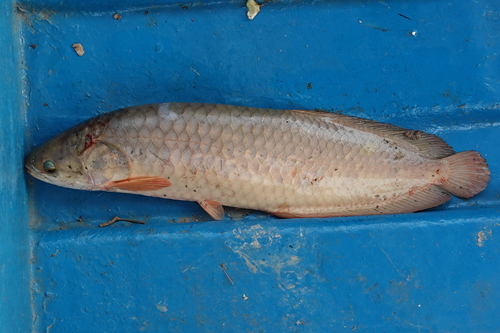
The Arapaima has a torpedo-shaped body, is mainly silver-grey and shows a plain pattern.
Where does the Arapaima live?
The Arapaima lives in fresh water and is mostly found around sand or mud bottom.
How big does the Arapaima get?
The Arapaima grows to a maximum of about 450 cm. On average the species is around 200 cm.
Is the Arapaima dangerous to humans?
No, the Arapaima is harmless to humans.
Is the Arapaima edible?
Yes, the Arapaima is commonly eaten.
Download Fin's Fish Guide
Identify fish in seconds, log your catches and dives. Join the TestFlight beta.
All data
Identification
Appearance
Habitat & distribution
Behaviour & biology
For anglers
Safety
Status & sources
More from the family Arapaimidae
Download Fin's Fish Guide
Identify fish in seconds, log your catches and dives. Join the TestFlight beta.