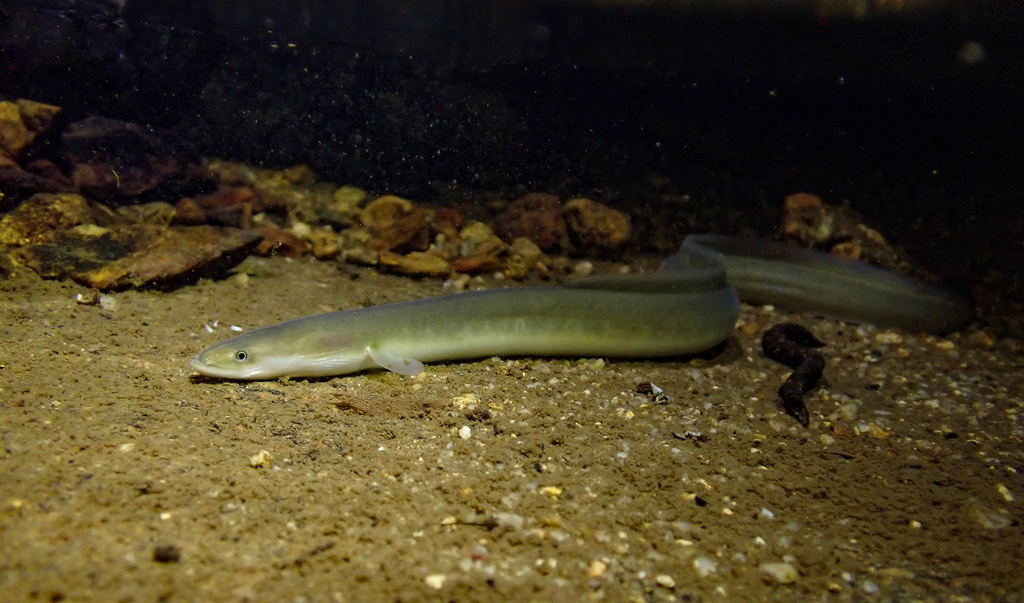
The Japanese eel (Anguilla japonica) is a fish that lives in both fresh and salt water of the family Anguillidae that grows up to 150 cm.
Description
The Japanese eel is a snake-shaped, catadromous migratory fish of the family Anguillidae reaching about 1.5 metres. The elongate body has a smooth, slimy skin and a long, continuous fin fringe over back, tail and belly. Like the European eel it grows up for years in fresh and brackish water of rivers, lakes and coasts of East Asia, and migrates once thousands of kilometres to spawning grounds in the open western Pacific, where it spawns and then dies; the transparent glass eels return with the currents. As unagi it is one of the most prized food fish of Japan. Through overfishing, dams, pollution and changing ocean currents it has declined sharply and is assessed as Endangered (EN).
Frequently asked questions
How do you recognise the Japanese eel?
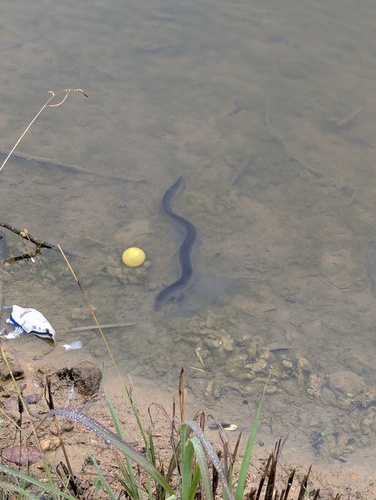
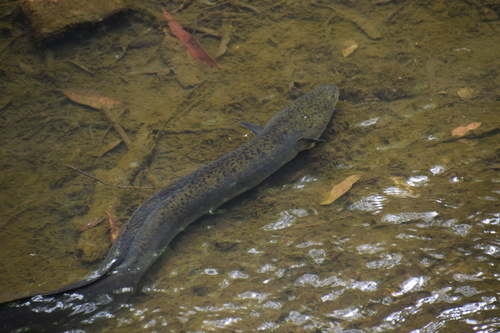
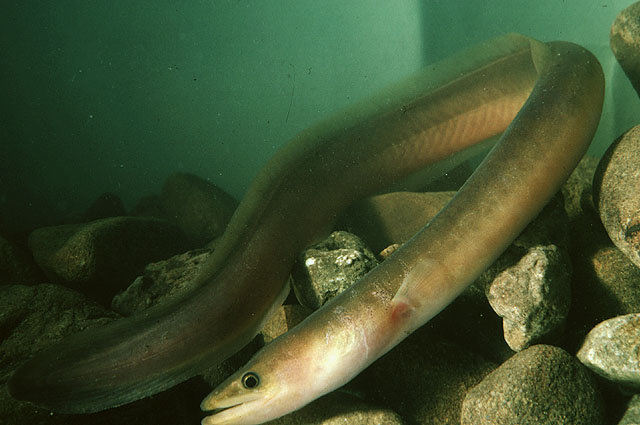
The Japanese eel has a snake-like body, is mainly brown and shows a plain pattern.
Where does the Japanese eel live?
The Japanese eel lives in both fresh and salt water and is mostly found around sand or mud bottom.
How big does the Japanese eel get?
The Japanese eel grows to a maximum of about 150 cm. On average the species is around 40 cm.
Is the Japanese eel dangerous to humans?
No, the Japanese eel is harmless to humans.
Is the Japanese eel edible?
Yes, the Japanese eel is a highly prized food fish.
Download Fin's Fish Guide
Identify fish in seconds, log your catches and dives. Join the TestFlight beta.
All data
Identification
Appearance
Habitat & distribution
Behaviour & biology
For anglers
Safety
Status & sources
Same genus Anguilla

More from the family Anguillidae

Download Fin's Fish Guide
Identify fish in seconds, log your catches and dives. Join the TestFlight beta.