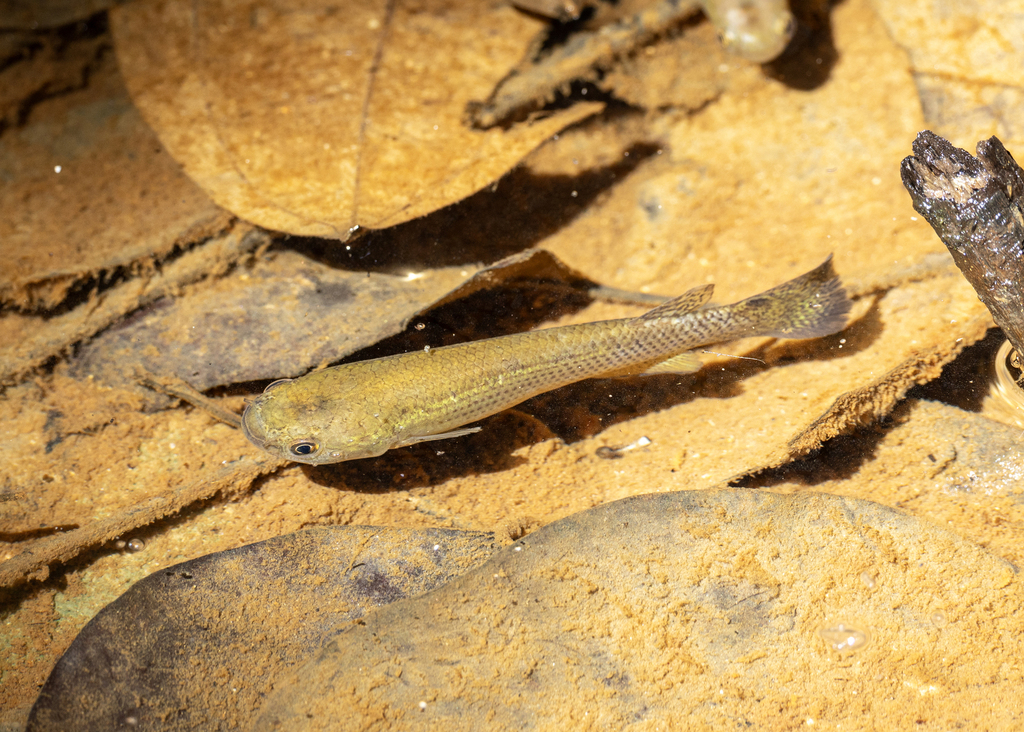
The Giant rivulus (Anablepsoides hartii) is a brackish-water fish of the family Rivulidae that grows up to 10 cm.
Description
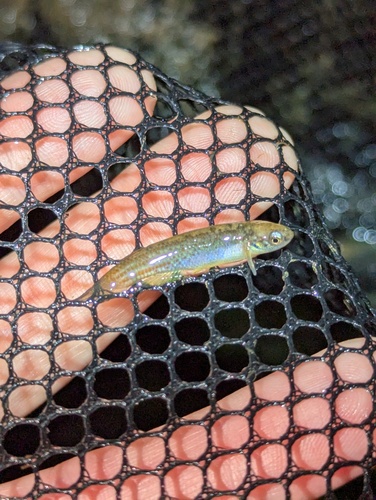
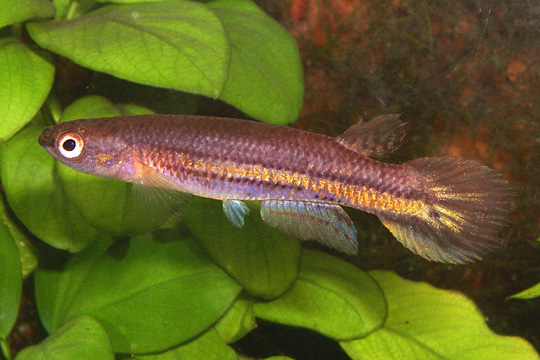
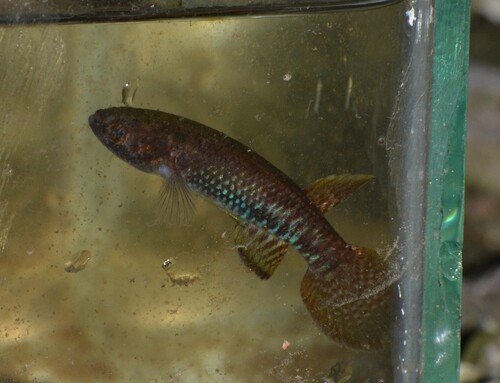
Hart's rivulus is a killifish (Rivulidae) from northern South America and Trinidad. The species grows to about 10 cm and has an elongate, yellow-brown body with rows of red spots and a rounded tail. It occurs at the foot of waterfalls, in swamps, streams and ponds, and can move across moist land to nearby water. Unlike many related killifishes it is not a seasonal fish. As a small predator it hunts insects, small crustaceans and small fishes. It is eaten in its range and exported for the aquarium trade. The species is harmless to humans.
Frequently asked questions
How do you recognise the Giant rivulus?
The Giant rivulus has an elongate, eel-like body, is mainly brown and shows a spots pattern.
Where does the Giant rivulus live?
The Giant rivulus lives in brackish water and is mostly found around mixed bottom.
How big does the Giant rivulus get?
The Giant rivulus grows to a maximum of about 10 cm.
Is the Giant rivulus dangerous to humans?
No, the Giant rivulus is harmless to humans.
Is the Giant rivulus edible?
The Giant rivulus is rarely eaten.
Download Fin's Fish Guide
Identify fish in seconds, log your catches and dives. Join the TestFlight beta.
All data
Identification
Appearance
Habitat & distribution
Behaviour & biology
For anglers
Safety
Status & sources
Same genus Anablepsoides

More from the family Rivulidae


Download Fin's Fish Guide
Identify fish in seconds, log your catches and dives. Join the TestFlight beta.