
The Caspian shad (Alosa caspia) is a fish that lives in both fresh and salt water of the family Clupeidae that grows up to 32 cm.
Description
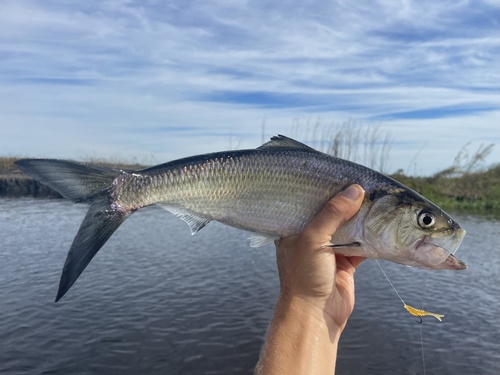
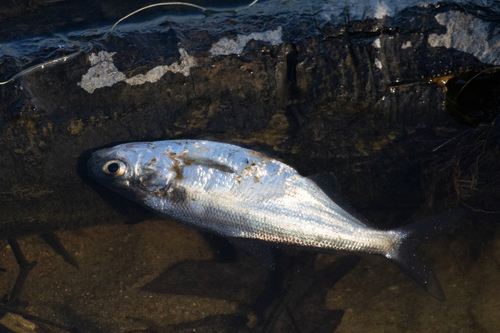
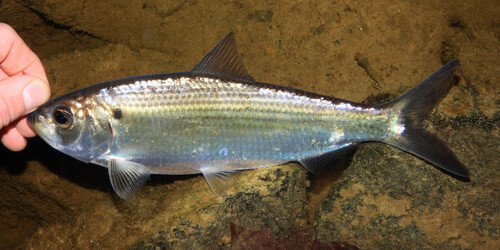
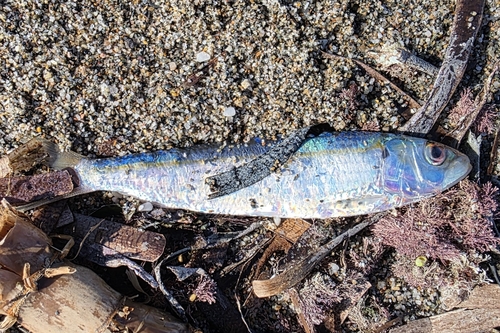
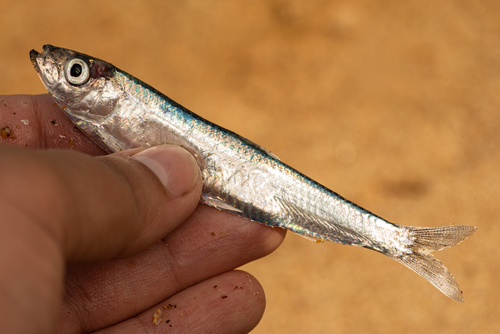
The Caspian shad is a herring-like migratory fish of the family Clupeidae reaching about 32 cm. The silvery, laterally compressed body has a bluish back, a saw-edged belly keel of scutes and often a row of dark shoulder spots behind the gill. The species lives in the Caspian Sea and the inflowing rivers and comprises several forms: some are anadromous and ascend the rivers to spawn, others stay in the brackish water of the sea. In schools it hunts zooplankton and small fish. The Caspian shad is locally a valued commercial fish. Through its large numbers it is also an important prey for predatory fish and waterbirds of the Caspian region.
Frequently asked questions
How do you recognise the Caspian shad?
The Caspian shad has a torpedo-shaped body, is mainly silver-grey and shows a plain pattern.
Where does the Caspian shad live?
The Caspian shad lives in both fresh and salt water and is mostly found around open water.
How big does the Caspian shad get?
The Caspian shad grows to a maximum of about 32 cm. On average the species is around 20 cm.
Is the Caspian shad dangerous to humans?
No, the Caspian shad is harmless to humans.
Is the Caspian shad edible?
Yes, the Caspian shad is commonly eaten.
Download Fin's Fish Guide
Identify fish in seconds, log your catches and dives. Join the TestFlight beta.
All data
Identification
Appearance
Habitat & distribution
Behaviour & biology
For anglers
Safety
Status & sources
Same genus Alosa

More from the family Clupeidae

Download Fin's Fish Guide
Identify fish in seconds, log your catches and dives. Join the TestFlight beta.