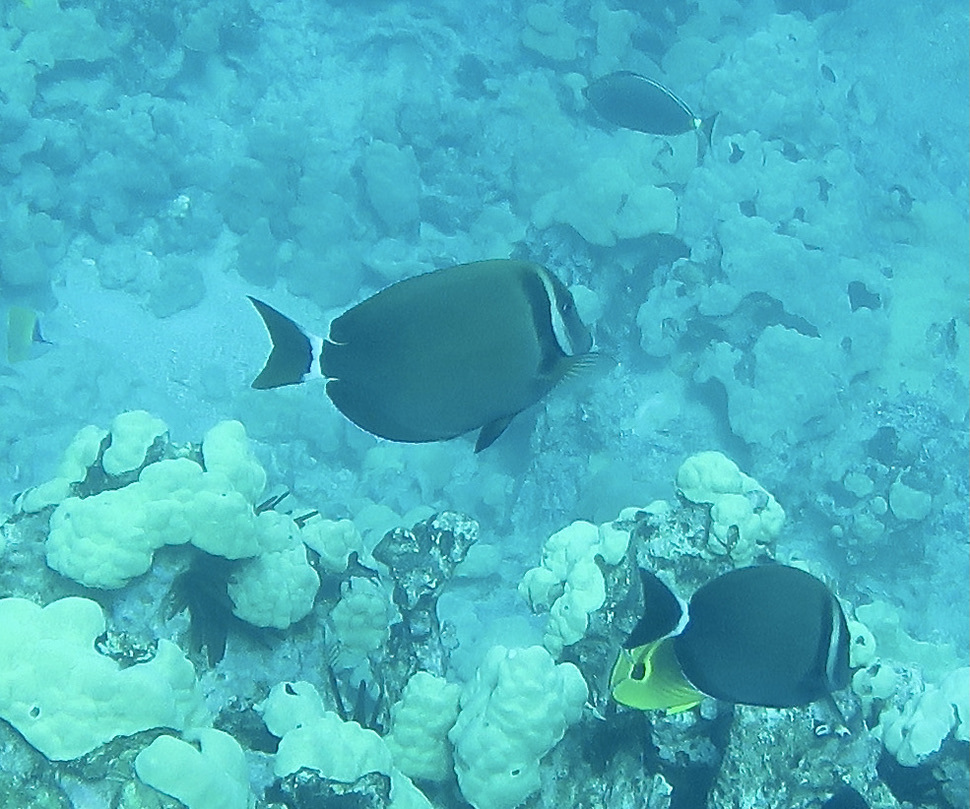
The Head-band surgeonfish (Acanthurus leucopareius) is a saltwater fish of the family Acanthuridae that grows up to 25 cm.
Description
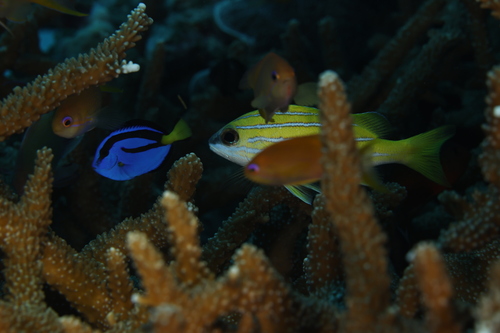
The whitebar surgeonfish is a surgeonfish from the western and central Pacific, including around the Hawaiian Islands. The species grows to about 25 cm and has an oval, brownish-grey body with a conspicuous white bar behind the eye. On either side of the tail base it carries a sharp, scalpel-like spine that can inflict serious cuts. As a grazer it lives in the turbulent surge zone and eats filamentous algae. The fish is a local food fish. The IUCN assesses the species as Least Concern (LC).
Frequently asked questions
How do you recognise the Head-band surgeonfish?
The Head-band surgeonfish has a flattened, disc-shaped body, is mainly brown and shows a vertical stripes pattern.
Where does the Head-band surgeonfish live?
The Head-band surgeonfish lives in the sea (marine waters) and is mostly found around stony or rocky ground.
How big does the Head-band surgeonfish get?
The Head-band surgeonfish grows to a maximum of about 25 cm.
Is the Head-band surgeonfish dangerous to humans?
The Head-band surgeonfish can cause injury; handle it with care.
Is the Head-band surgeonfish edible?
Yes, the Head-band surgeonfish is commonly eaten.
Download Fin's Fish Guide
Identify fish in seconds, log your catches and dives. Join the TestFlight beta.
All data
Identification
Appearance
Habitat & distribution
Behaviour & biology
For anglers
Safety
Status & sources
Same genus Acanthurus
More from the family Acanthuridae
Download Fin's Fish Guide
Identify fish in seconds, log your catches and dives. Join the TestFlight beta.