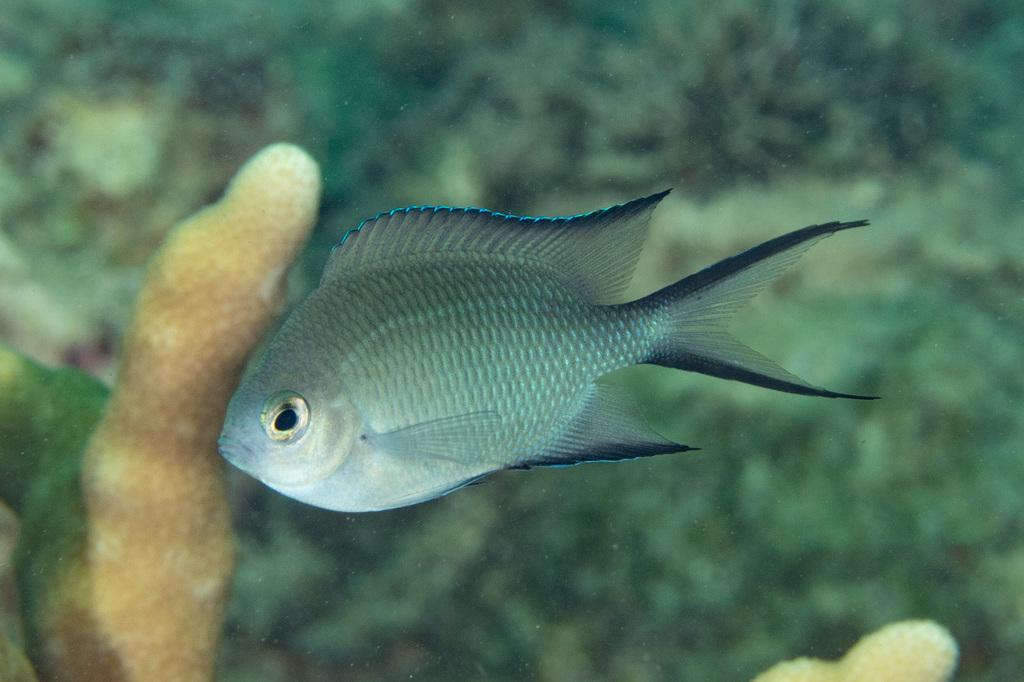
The Damselfish (Acanthochromis polyacanthus) is a saltwater fish of the family Pomacentridae that grows up to 16 cm.
Description
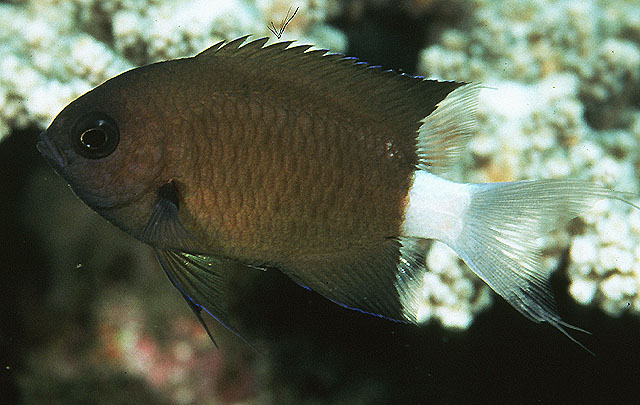
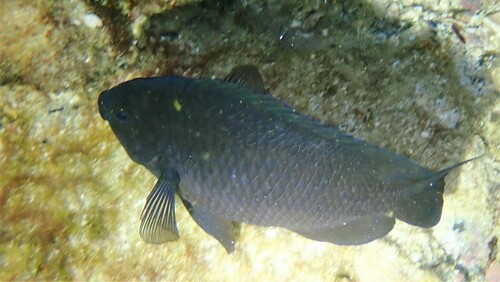
The spiny chromis is a damselfish of the family Pomacentridae from the western Pacific. The species grows to about 16 cm and has a stocky body grading from dark at the head to lighter at the tail. Adults inhabit inshore and offshore coral reefs. Notably, this is the only damselfish without a pelagic larval stage: the young hatch directly as small fish and stay with the parents, who protect and defend the brood for weeks. As an omnivore it feeds on zooplankton, algae and small invertebrates. The species is harmless to humans.
Frequently asked questions
How do you recognise the Damselfish?
The Damselfish has a flattened, disc-shaped body, is mainly brown and shows a plain pattern.
Where does the Damselfish live?
The Damselfish lives in the sea (marine waters) and is mostly found around stony or rocky ground.
How big does the Damselfish get?
The Damselfish grows to a maximum of about 16 cm.
Is the Damselfish dangerous to humans?
No, the Damselfish is harmless to humans.
Is the Damselfish edible?
The Damselfish is not usually eaten.
Download Fin's Fish Guide
Identify fish in seconds, log your catches and dives. Join the TestFlight beta.
All data
Identification
Appearance
Habitat & distribution
Behaviour & biology
For anglers
Safety
Status & sources
More from the family Pomacentridae
Download Fin's Fish Guide
Identify fish in seconds, log your catches and dives. Join the TestFlight beta.